What I've written this month that lives elsewhere:
Why Almost Everything You Know About Star Wars Is Now Wrong, for KQED Pop, in which we discuss retcons, Star Wars, and ecumenical councils.
Review: Spider-Man 2099 #1 for The Beat, which has long been by NYT of comics news, in which we discuss last century's future superheroes, anti-hero secret identities, and the Spider-Man we deserve.
Which is a nice segue into the ANNOUNCEMENT that I'll be helping to cover San Diego Comic Con for The Beat this year! I'll be writing up panels & news & hopefully doing some Artist Alley spot interviews. I expect SDCC will be a bit too crazy to link to articles here as they go up, but I'll surely do a round-up on the other side.
As briefly mentioned above, The Beat has been a personal lighthouse in the dark for comics journalism for 10 years, and I'm excited to contribute this year. Heidi MacDonald, The Beat's editor-in-chief and the sun god of comics reporting if-you-ask-me, is passionate about the medium and passionate about writing about the medium, in a way that goes beyond linking to press releases and storyline speculation. I'm super pleased and excited.
IN OTHER NEWS: I'm also pleased and excited an official female Thor coming to Marvel Comics. I mean, it's not my long-dreamed-of erasure of Superman and permanent replacement by Supergirl, but it still sounds pretty neat to me.
Showing posts with label writing. Show all posts
Showing posts with label writing. Show all posts
Tuesday, July 15, 2014

Thursday, October 31, 2013
I Remember Arnie
I met Arnie Raiff in ... 2003. We were both taking Carey Friedman's Experimental Theater class and it was my first semester at Columbia College Chicago. I had decided to go back to school because I was restless and aimless and wanted to write a lot. Arnie was teaching there, and taking classes that interested him. I was already intimidated, taking an experimental theater class before I'd taken any normal theater classes, but now I was taking it alongside a teacher and a bunch of grad students. But I was kind of dumb, so I didn't let it bother me too much.
But I felt comfortable around Arnie from the first time I saw him. He had a scraggly beard and a scratchy voice. He wore newsboy caps and baggy sweaters. He didn't look like a writing teacher auditing a class. He looked like a guy, a Chicago guy, and he was eager to ask questions when he didn't quite get something yet, and he was quick to get excited when he got it. We didn't talk much, one on one. I didn't talk to anyone much, one on one, that semester. Maybe that whole year. I was nervous about being back in school and being found out for a fraud and a terrible writer. I remember having something I wrote read aloud in class one day, and hearing Arnie laugh at one of the right places. I don't even remember what I wrote. I just remember that he laughed.
That summer Arnie taught a writing workshop I took. The focus was creative nonfiction. I read "Shooting an Elephant" for the first time in his class, and it was one of the first stories I taught to students of my own later. He talked about unions and looked at me with a little bit of disbelief when I said that my dad was in a union, but couldn't quite articulate what he did at work every day. I investigated imaginary friends as my final project for that class, not conscious that it was because, even after nearly two years in Chicago and one year back in school, I still felt so separate from a lot of real humans.
But that meant there were figures like Arnie that loomed large. Writers who had gone through the process. Arnie was still exploring his work and his craft, still struggling with making himself understood, but also eager to help others find their voices. I didn't have an intense personal connection with him. Except for the one that came from being fellow travelers who were in the same place for a little while. We walked and read and wrote together, for a little while.
This morning, I woke up in a city far from Chicago and scrolled through Facebook to help jumpstart my brain. To see what the world was up to while I was asleep. I read that Arnie Raiff died peacefully at home on October 29, ending his long battle with cancer.
I haven't seen Arnie in person since 2006, when I left Chicago for California, the first time. But I have thought about him -- this is no joke -- on a regular basis ever since, trying to explain the Chicago-centric pop culture references from Spider-Man 2. "'He's Back,'" Arnie said, pretending to hold up a newspaper. "That's Michael Jordan!" I don't know why that pops into my head as often as it does. I would imagine Arnie didn't think too much about Spider-Man 2 after that summer. But that's how I see him, as the focus of that semi-circle in a little room on South Michigan Avenue, holding court and talking about stories. Write on, brother.
But I felt comfortable around Arnie from the first time I saw him. He had a scraggly beard and a scratchy voice. He wore newsboy caps and baggy sweaters. He didn't look like a writing teacher auditing a class. He looked like a guy, a Chicago guy, and he was eager to ask questions when he didn't quite get something yet, and he was quick to get excited when he got it. We didn't talk much, one on one. I didn't talk to anyone much, one on one, that semester. Maybe that whole year. I was nervous about being back in school and being found out for a fraud and a terrible writer. I remember having something I wrote read aloud in class one day, and hearing Arnie laugh at one of the right places. I don't even remember what I wrote. I just remember that he laughed.
That summer Arnie taught a writing workshop I took. The focus was creative nonfiction. I read "Shooting an Elephant" for the first time in his class, and it was one of the first stories I taught to students of my own later. He talked about unions and looked at me with a little bit of disbelief when I said that my dad was in a union, but couldn't quite articulate what he did at work every day. I investigated imaginary friends as my final project for that class, not conscious that it was because, even after nearly two years in Chicago and one year back in school, I still felt so separate from a lot of real humans.
But that meant there were figures like Arnie that loomed large. Writers who had gone through the process. Arnie was still exploring his work and his craft, still struggling with making himself understood, but also eager to help others find their voices. I didn't have an intense personal connection with him. Except for the one that came from being fellow travelers who were in the same place for a little while. We walked and read and wrote together, for a little while.
This morning, I woke up in a city far from Chicago and scrolled through Facebook to help jumpstart my brain. To see what the world was up to while I was asleep. I read that Arnie Raiff died peacefully at home on October 29, ending his long battle with cancer.
I haven't seen Arnie in person since 2006, when I left Chicago for California, the first time. But I have thought about him -- this is no joke -- on a regular basis ever since, trying to explain the Chicago-centric pop culture references from Spider-Man 2. "'He's Back,'" Arnie said, pretending to hold up a newspaper. "That's Michael Jordan!" I don't know why that pops into my head as often as it does. I would imagine Arnie didn't think too much about Spider-Man 2 after that summer. But that's how I see him, as the focus of that semi-circle in a little room on South Michigan Avenue, holding court and talking about stories. Write on, brother.
Thursday, August 22, 2013
Fiction: Coda -- Roy Raven
[This is the third of three shorties I wrote about Roy Raven, my Pathfinder character of a year or so. This was written after the campaign's close, when the playing was done and our group had drifted to different corners of the country.
Kendra was an NPC that I decided Roy might wind up traveling with. I wrote this on the plane as Kate and I were flying to San Diego to look for an apartment after a rather all-of-a-sudden decision to move to California. I didn't look at, or share, this story with the rest of my group until just last week -- I didn't even realize, when I was writing it, that I was writing about Kate and myself moving and leaving the Diplomancers, just like Roy and Kendra were leaving the Bugbears.]
The fires burned low as the sun rose. Kendra came back -- Roy hadn't noticed her go -- and softly cleared her throat.
"Right," said Roy. "Probably time to get."
"You promised to catch up with them before Caliphas," she said.
"I did say that," said Roy. "That is a thing that I said."
"You lingered awfully long as you said it too. Like someone who was stalling."
"I have been known to stall, it's true. From time to time." Roy Raven kicked at the dirt of the reconsecrated temple grounds. After the fight with the scholar -- after the Gallowspire had been sealed again and for all time -- the rest of the Bugbears had wanted to rest and recount their win and their spoils. Roy had felt antsy. He'd laid awake as the others slept, and he'd parted ways with them, only for a day, he promised, to wrap up any burials or loose spirits at Renchurch. Kendra had gone with him.
We're bonded now, she had said. We might should spend some time together.
Mostly the Bugbears didn't care. Fitzy had tried to tag along -- more and more toward the end he had been right there behind Roy -- but Roy shrugged off the goblin's assistance. It'll be boring, Roy explained. Spirit exorcisms, corpse re-burial. That kind of thing.
We never fully explored those stables, Fitzy had reasoned. There might be something--
Definitely not, Roy said. But if there is -- you've got dibs.
That had been enough to appease the little alchemist.
Kendra hadn't said anything, but Roy could tell she knew he was thinking of taking the opportunity to head in another direction.
"They'll be disappointed," she said now, like she could read his mind. Maybe she could? Who knew what almost-bonding with a lich godling could do to someone.
"They'll be fine," he said. "They know the songs. I was never that good of a banjo player. You heard us back in Ravengro."
"You did more than just banjo for them."
"Got them into trouble," offered Roy. "'What my friend here means to say...'" Roy had been quietly perfecting his Ganlow impression, but that was before the change. He'd somehow, incongrously, seemed to have lost some of that skill.
"They're fond of you for it," said Kendra.
Roy shrugged. "They are. All the same. I think I need to try something new. Honestly, when I think of going back on the road ... there's like a white border around that way of thinking. It's a vision of the past. It gives me a headache. I don't mean like a metaphor. It hurts, physically. Here." Roy tapped his temple.
"Pharasma touched you," said Kendra. "It's difficult to avoid destiny."
"You managed it," said Roy. "Destiny-wise, you should be the vessel for a lich-king right about now, yeah?"
"I avoided one destiny. I seem to have gotten mixed up with another. This bond we seem to have--"
"Ahh," Roy said, waving off her words. "I mean yeah, I get it. I'd just rather not -- let's not talk about it quite yet."
Kendra settled into an amused silence.
"Besides," said Roy, "I've been dodging destinies my whole life. I was raised by people, did you know that?"
"I didn't," said Kendra.
"It's true. Fisherman's family. For the first few years, anyway. So by most accounts, I should be inheriting a fishing boat or something."
"What happened?"
Roy pretended to have trouble remembering. "Nothing unusual. Brigand-related. Me and Sur -- he was my foster-brother, I suppose -- we headed to the city afterward. Got caught up in pickpocketing. So, by that destiny, I should have been a street rat forever, or else strung up in a jail somewhere in the Shackles. Or conscripted onto a pirate ship or something."
"I could see you as a pirate. A bird on your shoulder." She smirked.
"That Moesul, I swear. If I never see that particular weirdo again..."
"Aw, come on. Kaisen wasn't so bad."
"He had a pretty great belt," Roy conceded. " And his dancing was really improving, though I wouldn't tell him so to his face."
"Anyway," said Kendra. "What happened to pickpocket Roy? How was that destiny avoided?"
"Sur joined the army, believe it or not. Decided to fight for some lord or other, maybe earn his knighthood. I even thought about joining, for the sake of family togetherness. But it clearly wasn't for me. Bird bones, you know?"
"I do."
"So. I wound up learning a trade."
"Which one?"
Roy glanced at the graveyard, where not too many days previous he had buried his friend.
"One not far removed from what we're doing now. So maybe that particular destiny was just sidestepped for a few years. I picked up the banjo, and I just-so-happened to be enough of a weirdo for the freakshow that Deltaen was putting together at the time. Fitzy was already there, and then Myrtle joined shortly thereafter. And then Ganlow joined and stole all of my good ideas. We toured and we gigged, and then we met Muzzgash in the cemetery the day we -- well, you know. The day we buried your dad."
"And now here we are," said Kendra, smiling sadly, remembering the times before. "But where to next?"
"We could ask the planchette!" said Roy, perking up. He liked asking the planchette. "Follow the unquiet spirits about, help put them to rest."
"I'm a little tired of talking to ghosts," Kendra said. "The truth is -- I can hear them anyway."
"Yow. Really? That's creepy, Kendra."
"They're like whispers," she said, staring at something far away.
"Well, I can respect that. Taking a break from ghosts and all. It's just that -- well, I kind of have this deal. With Pharasma, I mean. I think it's kind of my job now."
"There's a lot of unquiet dead," said Kendra. "I don't know if we need to ask them anything. We could just -- travel. Follow our noses for a bit, instead of racing off to the next thing."
"I like to travel," agreed Roy. "It's been a long time since I've been down to the Shackles. Have you ever been?"
"Never," she said. "I hear it's -- well, actually I hear it's not very nice."
"Oh, it's not," Roy agreed. "But it is where I'm from."
"Let's go then," said Kendra. "Should we stop in Ravengro? I have some things that--"
"Aw, things," said Roy. "Things have never gotten anyone anywhere. You know what gets people places?"
"What?"
"Going."
Kendra smiled. "Then let's get going."
"Yeah," said Roy, as if it hadn't been his own idea. He took one more look around Renchurch in the rising sun, and it didn't look nearly as abandoned or as dreadful as it had when he'd first seen it. "And hey, maybe we'll catch up with those Bugbears someday anyway. That wouldn't be so bad."
Kendra was an NPC that I decided Roy might wind up traveling with. I wrote this on the plane as Kate and I were flying to San Diego to look for an apartment after a rather all-of-a-sudden decision to move to California. I didn't look at, or share, this story with the rest of my group until just last week -- I didn't even realize, when I was writing it, that I was writing about Kate and myself moving and leaving the Diplomancers, just like Roy and Kendra were leaving the Bugbears.]
The fires burned low as the sun rose. Kendra came back -- Roy hadn't noticed her go -- and softly cleared her throat.
"Right," said Roy. "Probably time to get."
"You promised to catch up with them before Caliphas," she said.
"I did say that," said Roy. "That is a thing that I said."
"You lingered awfully long as you said it too. Like someone who was stalling."
"I have been known to stall, it's true. From time to time." Roy Raven kicked at the dirt of the reconsecrated temple grounds. After the fight with the scholar -- after the Gallowspire had been sealed again and for all time -- the rest of the Bugbears had wanted to rest and recount their win and their spoils. Roy had felt antsy. He'd laid awake as the others slept, and he'd parted ways with them, only for a day, he promised, to wrap up any burials or loose spirits at Renchurch. Kendra had gone with him.
We're bonded now, she had said. We might should spend some time together.
Mostly the Bugbears didn't care. Fitzy had tried to tag along -- more and more toward the end he had been right there behind Roy -- but Roy shrugged off the goblin's assistance. It'll be boring, Roy explained. Spirit exorcisms, corpse re-burial. That kind of thing.
We never fully explored those stables, Fitzy had reasoned. There might be something--
Definitely not, Roy said. But if there is -- you've got dibs.
That had been enough to appease the little alchemist.
Kendra hadn't said anything, but Roy could tell she knew he was thinking of taking the opportunity to head in another direction.
"They'll be disappointed," she said now, like she could read his mind. Maybe she could? Who knew what almost-bonding with a lich godling could do to someone.
"They'll be fine," he said. "They know the songs. I was never that good of a banjo player. You heard us back in Ravengro."
"You did more than just banjo for them."
"Got them into trouble," offered Roy. "'What my friend here means to say...'" Roy had been quietly perfecting his Ganlow impression, but that was before the change. He'd somehow, incongrously, seemed to have lost some of that skill.
"They're fond of you for it," said Kendra.
Roy shrugged. "They are. All the same. I think I need to try something new. Honestly, when I think of going back on the road ... there's like a white border around that way of thinking. It's a vision of the past. It gives me a headache. I don't mean like a metaphor. It hurts, physically. Here." Roy tapped his temple.
"Pharasma touched you," said Kendra. "It's difficult to avoid destiny."
"You managed it," said Roy. "Destiny-wise, you should be the vessel for a lich-king right about now, yeah?"
"I avoided one destiny. I seem to have gotten mixed up with another. This bond we seem to have--"
"Ahh," Roy said, waving off her words. "I mean yeah, I get it. I'd just rather not -- let's not talk about it quite yet."
Kendra settled into an amused silence.
"Besides," said Roy, "I've been dodging destinies my whole life. I was raised by people, did you know that?"
"I didn't," said Kendra.
"It's true. Fisherman's family. For the first few years, anyway. So by most accounts, I should be inheriting a fishing boat or something."
"What happened?"
Roy pretended to have trouble remembering. "Nothing unusual. Brigand-related. Me and Sur -- he was my foster-brother, I suppose -- we headed to the city afterward. Got caught up in pickpocketing. So, by that destiny, I should have been a street rat forever, or else strung up in a jail somewhere in the Shackles. Or conscripted onto a pirate ship or something."
"I could see you as a pirate. A bird on your shoulder." She smirked.
"That Moesul, I swear. If I never see that particular weirdo again..."
"Aw, come on. Kaisen wasn't so bad."
"He had a pretty great belt," Roy conceded. " And his dancing was really improving, though I wouldn't tell him so to his face."
"Anyway," said Kendra. "What happened to pickpocket Roy? How was that destiny avoided?"
"Sur joined the army, believe it or not. Decided to fight for some lord or other, maybe earn his knighthood. I even thought about joining, for the sake of family togetherness. But it clearly wasn't for me. Bird bones, you know?"
"I do."
"So. I wound up learning a trade."
"Which one?"
Roy glanced at the graveyard, where not too many days previous he had buried his friend.
"One not far removed from what we're doing now. So maybe that particular destiny was just sidestepped for a few years. I picked up the banjo, and I just-so-happened to be enough of a weirdo for the freakshow that Deltaen was putting together at the time. Fitzy was already there, and then Myrtle joined shortly thereafter. And then Ganlow joined and stole all of my good ideas. We toured and we gigged, and then we met Muzzgash in the cemetery the day we -- well, you know. The day we buried your dad."
"And now here we are," said Kendra, smiling sadly, remembering the times before. "But where to next?"
"We could ask the planchette!" said Roy, perking up. He liked asking the planchette. "Follow the unquiet spirits about, help put them to rest."
"I'm a little tired of talking to ghosts," Kendra said. "The truth is -- I can hear them anyway."
"Yow. Really? That's creepy, Kendra."
"They're like whispers," she said, staring at something far away.
"Well, I can respect that. Taking a break from ghosts and all. It's just that -- well, I kind of have this deal. With Pharasma, I mean. I think it's kind of my job now."
"There's a lot of unquiet dead," said Kendra. "I don't know if we need to ask them anything. We could just -- travel. Follow our noses for a bit, instead of racing off to the next thing."
"I like to travel," agreed Roy. "It's been a long time since I've been down to the Shackles. Have you ever been?"
"Never," she said. "I hear it's -- well, actually I hear it's not very nice."
"Oh, it's not," Roy agreed. "But it is where I'm from."
"Let's go then," said Kendra. "Should we stop in Ravengro? I have some things that--"
"Aw, things," said Roy. "Things have never gotten anyone anywhere. You know what gets people places?"
"What?"
"Going."
Kendra smiled. "Then let's get going."
"Yeah," said Roy, as if it hadn't been his own idea. He took one more look around Renchurch in the rising sun, and it didn't look nearly as abandoned or as dreadful as it had when he'd first seen it. "And hey, maybe we'll catch up with those Bugbears someday anyway. That wouldn't be so bad."
Saturday, August 17, 2013
An Interview With Ben Costa
I just interviewed my friend Ben Costa for the Longbox Project about his life and work in comics. I'm really proud of it! You should go read it.
One of the first things I did when I moved to San Francisco in 2006 was I went to my grad school's meet n' greet. It was pretty scary. I was 27, I'd just moved across the country to attend an MFA writing program in San Francisco, a place I had barely ever visited before. There were writerly introverts, writerly extroverts, intimidating new instructors, and a whole new social world to decipher.
And there, where the sea of humanity parted.
A gangly tall dude with scruffy hair and a Usagi Yojimbo t-shirt.
I had found one of my people.
When the rest of the CCA gang were going out drinking or carousing or troublemaking over those two years in our MFA program, Ben would hang out for a round (sometimes) or a joke or two after class (usually) and then excuse himself to go home and draw pages from his comic, which then only existed on the web. It was (and still is) called Shi Long Pang, the Wandering Shaolin Monk. Ben was award one of the last Xeric grants to publish the first volume of Pang in hardcover, and earlier this year he successfully Kickstartered volume 2. Ben debuted the new volume at Comic Con 2013, and he's sending out copies to his Kickstarter funders any day now.
Ben's a damn good friend and a weird dude and I like him a lot. I'm hella proud of the work he's done and the manner in which he does it: how he wants, and to exceedingly high standards of quality. Read the interview, read his book, and check out the beard that won him the CCA 2008 beard-growing contest:
One of the first things I did when I moved to San Francisco in 2006 was I went to my grad school's meet n' greet. It was pretty scary. I was 27, I'd just moved across the country to attend an MFA writing program in San Francisco, a place I had barely ever visited before. There were writerly introverts, writerly extroverts, intimidating new instructors, and a whole new social world to decipher.
And there, where the sea of humanity parted.
A gangly tall dude with scruffy hair and a Usagi Yojimbo t-shirt.
I had found one of my people.
 |
| Ben Costa, Amy Martin, and me, with our comics at APE in 2007. Two of these people went on to be successful comic creators! |
When the rest of the CCA gang were going out drinking or carousing or troublemaking over those two years in our MFA program, Ben would hang out for a round (sometimes) or a joke or two after class (usually) and then excuse himself to go home and draw pages from his comic, which then only existed on the web. It was (and still is) called Shi Long Pang, the Wandering Shaolin Monk. Ben was award one of the last Xeric grants to publish the first volume of Pang in hardcover, and earlier this year he successfully Kickstartered volume 2. Ben debuted the new volume at Comic Con 2013, and he's sending out copies to his Kickstarter funders any day now.
Ben's a damn good friend and a weird dude and I like him a lot. I'm hella proud of the work he's done and the manner in which he does it: how he wants, and to exceedingly high standards of quality. Read the interview, read his book, and check out the beard that won him the CCA 2008 beard-growing contest:
 |
| Me; Ben; Ben's Beard; 2008. |
Monday, April 22, 2013
Writing About Comics, Writing About Life
The Longbox Project is a site that asks folks to share memories tied to specific issues in their comic book collections. This technically means "Amazing Spider-Man #258 makes me think of...", but it's just as likely to mean "For 25 years I've carried some low-level guilt around about the time I stole something from my big brother, and I finally have an excuse to confess it."
You don't have to be a writer or a writer-about-comics to take part. It's not a comics criticism site so much as a memory project, and the posts tend to be conversational and honest. I wrote a new one that's up today called I Own This about the fairly traumatic period of my life when I moved from Los Angeles to Vermont to Baltimore in the span of 7 months.
What I said about it on Facebook, and what I wrote down on a legal pad as soon as I'd written the first draft of this piece, is "Sometimes you write something and say it's embarrassing because of how cool it makes you look and you want to seem humble. Sometimes you say it's embarrassing because it reveals the kind of asshole you can be. This is the second kind."
So, it feels very revealing to share this story with my friends and the internet-at-large. Kate and I sat on the couch last night before I officially submitted it so she could read and we could talk about it before I showed it to the world. I'd told Kate parts of the story before, but not the version that's presented there. And there are other parts that aren't in the Longbox version (sorry gang, I was already over the word count, but I'm happy to go on about it in person), and I told Kate those parts too.
I was nervous she'd think less of me. But what she said was, "I don't think learning more could make me think less."
So if you like comics, gossip, cross-country moves, Vermont, or confessionals, go read I Own This on the Longbox Project. I wrote it!

You don't have to be a writer or a writer-about-comics to take part. It's not a comics criticism site so much as a memory project, and the posts tend to be conversational and honest. I wrote a new one that's up today called I Own This about the fairly traumatic period of my life when I moved from Los Angeles to Vermont to Baltimore in the span of 7 months.
What I said about it on Facebook, and what I wrote down on a legal pad as soon as I'd written the first draft of this piece, is "Sometimes you write something and say it's embarrassing because of how cool it makes you look and you want to seem humble. Sometimes you say it's embarrassing because it reveals the kind of asshole you can be. This is the second kind."
So, it feels very revealing to share this story with my friends and the internet-at-large. Kate and I sat on the couch last night before I officially submitted it so she could read and we could talk about it before I showed it to the world. I'd told Kate parts of the story before, but not the version that's presented there. And there are other parts that aren't in the Longbox version (sorry gang, I was already over the word count, but I'm happy to go on about it in person), and I told Kate those parts too.
I was nervous she'd think less of me. But what she said was, "I don't think learning more could make me think less."
So if you like comics, gossip, cross-country moves, Vermont, or confessionals, go read I Own This on the Longbox Project. I wrote it!
Friday, February 03, 2012
The Five Foundational Texts
My pal Adam has a novel in which the main character brings 5 books with him to college, the 5 tomes that have shaped his brain and his bones up to that point. It's an idea that has stuck with me since I first read it a few years ago, and since I've been rebuilding my library these days I've been thinking about what my Five Foundational Texts might have been...
1.

Advanced Dungeons & Dragons 2nd Edition Player's Handbook
by David "Zeb" Cook, 1989.
This was the rulebook for what still takes up a whole lot of my headspace, even when I'm not actively playing D&D. My brother played D&D, but I never did much more than watch him and his buddies play around the pool table from time to time. But when I was in high school I fell in with some of the kids in band who had a D&D group, and thereafter spent more weekends than not playing in my basement, or John Bennington's living room, or James Laird's dining room. It was partly the swords-and-sorcery, playing pretend part of D&D that made it attractive, but I think it was also the fact that it was a group activity. As a younger kid I mostly played one-on-one, but sitting around a table for Dungeons & Dragons brought about a kind of collaborative storytelling that I've never shaken the jones for. Reading over the handbook between games -- or during some stretches between gaming groups -- brought to mind all of the possibilities for Adventurers and Adventuring Parties, and I definitely imagined and rolled up more characters than I ever put into play. In reasons I still don't entirely understand, I think playing D&D is what encouraged me to move from Ohio to Chicago. Something about "let's see what's over that next rise..."
2.

Marvel Saga
by Peter Sanderson & the Marvel Bullpen, 1985-87.
I could just say "Marvel Comics from the 1980s, specifically whatever my brother Dave had in his footlocker from 1994-1988," but if I had to pare it down to a volume that can exist on a bookshelf it would be this. This one reminds me of play, too -- it was certainly the precursor to the imagined comic books I wrote scripts & summaries for in middle school and high school, and combined with Marvel Universe, it gave me an encyclopedic mythology I could explore, meditate on, interpret, and -- once the idea of the written by credit had sunk in -- contribute to. It was essentially a retelling of the events of the Marvel Universe, in order, beginning with the Celestials arrival on Earth "roughly one million years ago" and their creation of the Eternals and the Deviants, and ending with the Fantastic Four's battle with Galactus from Fantastic Four #s 48-50. The series used blocks of text mixed with original art from vintage Marvel Comics as well as new art used to fill in some of the gaps. Each issue would have some sort of focus -- "See today's X-Factor in their first battle, when they were the original X-Men!" -- but it generally covered the crannies and side stories of the Marvel Universe from Spider-Man to Daredevil to Alpha Flight, making connections that I'd glimpsed in editorial notes of the normal comics I read, but now explained in a way that revealed just how big and interconnected those stories were.
3.

The Greek Myths
Translated/Retold by Robert Graves, 1955.
Speaking of mythologies... there was a hardcover copy of Ancient Greek myths in the Clermont Northeastern Intermediate School Library that I used to check out and re-read over and over again. I don't know now if it was the Robert Graves version -- I kind of doubt it -- but I don't remember much about the specific edition except it was a hardcover, it was gray, it was lacking a dustjacket, and "Greek Myths" was printed in gold on the spine. I'm sure the subject matter fed something similar to the Marvel Comics I read over and over again, but I also think it was an important step toward, you know, reading actual words on paper, understanding and enjoying how they fit together, resonating in a way that comic book word balloons don't. I'm not talking smack about comics as much as I'm saying -- look, they ain't poetry. I remember the version of the Greek Myths I read was simple and sparse in a way that pushed me to fill in the details. The less they told, the more I saw. I checked that book out ever other week, I think. I think about those guys the same way I think about Pete Laub and Jimmy Daniel. My relationships with Zeus and Heracles and Apollo were just as formative as with the guys with whom I pretended to be Lost Boys (the vampires, not the boy runaways).
4.

Macbeth
by William Shakespeare, 1605-ish.
Spectral daggers, witches three, medieval battles -- if I've made anything clear to you in our time together, it is that these things are right up my alley. And if you wanna talk about expanding one's understanding of language's potential -- I mean, "By the pricking of my thumbs/Something wicked this way comes/Open, locks, whoever knocks!" is certainly enough to blow open the brain of a seventeen-year-old me.
And it will always have a place in my heart for being the play that Charlie Hartman, Josh Lawson and I reenacted with sock puppets and Castle Grayskull for our 12th grade English class.

5.

The Illuminatus! Trilogy
by Robert Shea & Robert Anton Wilson, 1975/1984.
Writing this post, I've been surprised at how hard it's been to put an honest-to-gosh novel on here. I remember that for a big chunk of junior high/high school, my answer to What's your favorite book? was The DragonLance Chronicles: Dragons of Autumn Twilight, which was the first book I loved so much that I read it nonstop for three days over one summer break. But looking back, it doesn't stick with me much more than watching lots of GI Joe. It was a fun book, but it didn't change anything about how my brain worked.
Illuminatus!, on the other hand -- it was fun, dirty, weird, and by far the longest book I'd ever read at that point. It also dovetailed nicely with my musical obsession with the KLF/JAMs/Justified Ancients of Mu Mu by sharing some of the same conspiracy theory-fueled mythology. It was the book I carried in my backpack so much that it started to fall apart, and it was the book I most wanted other people to catch me reading. I thought about fnords forever after, I thought about authorial pranks and unreliable narrators, I thought about a plot that comments on itself as you're reading it and dares you to keep up. I didn't necessarily understand all of it then (or now), but I knew that I liked the feelings it made me feel.
I think it would be easier to pull together a list of Foundational Texts from my 20s, and maybe that's what I'll do next. I imagine that list speak more to how I write and what I write about now -- this list, as I look over it, speaks to how I think and what I think about now. Which is what foundational is supposed to mean, yeah?
1.

Advanced Dungeons & Dragons 2nd Edition Player's Handbook
by David "Zeb" Cook, 1989.
This was the rulebook for what still takes up a whole lot of my headspace, even when I'm not actively playing D&D. My brother played D&D, but I never did much more than watch him and his buddies play around the pool table from time to time. But when I was in high school I fell in with some of the kids in band who had a D&D group, and thereafter spent more weekends than not playing in my basement, or John Bennington's living room, or James Laird's dining room. It was partly the swords-and-sorcery, playing pretend part of D&D that made it attractive, but I think it was also the fact that it was a group activity. As a younger kid I mostly played one-on-one, but sitting around a table for Dungeons & Dragons brought about a kind of collaborative storytelling that I've never shaken the jones for. Reading over the handbook between games -- or during some stretches between gaming groups -- brought to mind all of the possibilities for Adventurers and Adventuring Parties, and I definitely imagined and rolled up more characters than I ever put into play. In reasons I still don't entirely understand, I think playing D&D is what encouraged me to move from Ohio to Chicago. Something about "let's see what's over that next rise..."
2.

Marvel Saga
by Peter Sanderson & the Marvel Bullpen, 1985-87.
I could just say "Marvel Comics from the 1980s, specifically whatever my brother Dave had in his footlocker from 1994-1988," but if I had to pare it down to a volume that can exist on a bookshelf it would be this. This one reminds me of play, too -- it was certainly the precursor to the imagined comic books I wrote scripts & summaries for in middle school and high school, and combined with Marvel Universe, it gave me an encyclopedic mythology I could explore, meditate on, interpret, and -- once the idea of the written by credit had sunk in -- contribute to. It was essentially a retelling of the events of the Marvel Universe, in order, beginning with the Celestials arrival on Earth "roughly one million years ago" and their creation of the Eternals and the Deviants, and ending with the Fantastic Four's battle with Galactus from Fantastic Four #s 48-50. The series used blocks of text mixed with original art from vintage Marvel Comics as well as new art used to fill in some of the gaps. Each issue would have some sort of focus -- "See today's X-Factor in their first battle, when they were the original X-Men!" -- but it generally covered the crannies and side stories of the Marvel Universe from Spider-Man to Daredevil to Alpha Flight, making connections that I'd glimpsed in editorial notes of the normal comics I read, but now explained in a way that revealed just how big and interconnected those stories were.
3.

The Greek Myths
Translated/Retold by Robert Graves, 1955.
Speaking of mythologies... there was a hardcover copy of Ancient Greek myths in the Clermont Northeastern Intermediate School Library that I used to check out and re-read over and over again. I don't know now if it was the Robert Graves version -- I kind of doubt it -- but I don't remember much about the specific edition except it was a hardcover, it was gray, it was lacking a dustjacket, and "Greek Myths" was printed in gold on the spine. I'm sure the subject matter fed something similar to the Marvel Comics I read over and over again, but I also think it was an important step toward, you know, reading actual words on paper, understanding and enjoying how they fit together, resonating in a way that comic book word balloons don't. I'm not talking smack about comics as much as I'm saying -- look, they ain't poetry. I remember the version of the Greek Myths I read was simple and sparse in a way that pushed me to fill in the details. The less they told, the more I saw. I checked that book out ever other week, I think. I think about those guys the same way I think about Pete Laub and Jimmy Daniel. My relationships with Zeus and Heracles and Apollo were just as formative as with the guys with whom I pretended to be Lost Boys (the vampires, not the boy runaways).
4.

Macbeth
by William Shakespeare, 1605-ish.
Spectral daggers, witches three, medieval battles -- if I've made anything clear to you in our time together, it is that these things are right up my alley. And if you wanna talk about expanding one's understanding of language's potential -- I mean, "By the pricking of my thumbs/Something wicked this way comes/Open, locks, whoever knocks!" is certainly enough to blow open the brain of a seventeen-year-old me.
And it will always have a place in my heart for being the play that Charlie Hartman, Josh Lawson and I reenacted with sock puppets and Castle Grayskull for our 12th grade English class.

5.
The Illuminatus! Trilogy
by Robert Shea & Robert Anton Wilson, 1975/1984.
Writing this post, I've been surprised at how hard it's been to put an honest-to-gosh novel on here. I remember that for a big chunk of junior high/high school, my answer to What's your favorite book? was The DragonLance Chronicles: Dragons of Autumn Twilight, which was the first book I loved so much that I read it nonstop for three days over one summer break. But looking back, it doesn't stick with me much more than watching lots of GI Joe. It was a fun book, but it didn't change anything about how my brain worked.
Illuminatus!, on the other hand -- it was fun, dirty, weird, and by far the longest book I'd ever read at that point. It also dovetailed nicely with my musical obsession with the KLF/JAMs/Justified Ancients of Mu Mu by sharing some of the same conspiracy theory-fueled mythology. It was the book I carried in my backpack so much that it started to fall apart, and it was the book I most wanted other people to catch me reading. I thought about fnords forever after, I thought about authorial pranks and unreliable narrators, I thought about a plot that comments on itself as you're reading it and dares you to keep up. I didn't necessarily understand all of it then (or now), but I knew that I liked the feelings it made me feel.
I think it would be easier to pull together a list of Foundational Texts from my 20s, and maybe that's what I'll do next. I imagine that list speak more to how I write and what I write about now -- this list, as I look over it, speaks to how I think and what I think about now. Which is what foundational is supposed to mean, yeah?
Monday, January 16, 2012
Emoticon, Emoticon, Emoticon
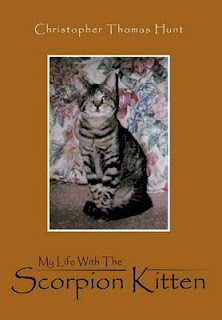
Chris Hunt is my uncle, and he wrote a book. It's called My Life with the Scorpion Kitten and it's about his life over the five-year period he spent with Mathias, a cat he adopted with his wife, my mom's sister, my aunt Tina.
Early in kitten-hood Mathias got a severe eye infection that cost him an eye, and left him blind in the eye he still had. He also had the feline leukemia virus, so I'll tell you straight up, dudes -- the book can carry the sadness at times. But from my personal perspective, what I found most interesting was the insight it offered into my family and some of the people in it.
The book covers the 5 years of Mathias's life, from 2003 to 2008. I lived in Chicago when it started and was just starting to wade back into the life of an undergrad. I started college right out of high school (CLASS OF 97 RULES), but after two years of bopping through the University of Cincinnati, I gradually dropped out of all of my classes. My last semester at UC had basically been a money pit, where my body knew I had dropped out (sleeping til 2pm or so) long before my brain had accepted it (obviously, blowing off my English Lit classes was simply the first the step toward changing my major to anthropology). But in 2003 I was attending classes at Columbia College Chicago as a Fiction Writing major. By the spring of 2008 I had earned my BA, left Chicago, and was wrapping up my MFA in Writing at California College of the Arts in San Francisco. Which is to say -- it was an eventful time in my life and I probably wasn't paying the best attention to family goings-on in Ohio. So in a lot of ways reading Chris's book was like reading one of those novels that gives a parallel view to stories you think you know well.
My grandmother passed away on Christmas Eve of 2004, and the way Chris writes about that night is different from the way I remember it. Chris is probably right -- I'm just surprised that I'd filled in so many details so incorrectly. I remembered our entire family being at Chris & Tina's that night -- my folks, my brother's family, my mom's older brother John and all of his kids. Grandma Mathews had been sick for a long time, and she'd been moved from hospice to Chris and Tina's, and she passed away while we were all there in the house. It was a strange, significant, sad Christmas. But Chris writes that John and his kids weren't there at all, and that John only came after Grandma had passed. I think that's probably true, but in my memory I'd created an entirely different sequence of events. Without reading Chris's book, I never would have entertained the thought I was wrong.


Early in kitten-hood Mathias got a severe eye infection that cost him an eye, and left him blind in the eye he still had. He also had the feline leukemia virus, so I'll tell you straight up, dudes -- the book can carry the sadness at times. But from my personal perspective, what I found most interesting was the insight it offered into my family and some of the people in it.

The book covers the 5 years of Mathias's life, from 2003 to 2008. I lived in Chicago when it started and was just starting to wade back into the life of an undergrad. I started college right out of high school (CLASS OF 97 RULES), but after two years of bopping through the University of Cincinnati, I gradually dropped out of all of my classes. My last semester at UC had basically been a money pit, where my body knew I had dropped out (sleeping til 2pm or so) long before my brain had accepted it (obviously, blowing off my English Lit classes was simply the first the step toward changing my major to anthropology). But in 2003 I was attending classes at Columbia College Chicago as a Fiction Writing major. By the spring of 2008 I had earned my BA, left Chicago, and was wrapping up my MFA in Writing at California College of the Arts in San Francisco. Which is to say -- it was an eventful time in my life and I probably wasn't paying the best attention to family goings-on in Ohio. So in a lot of ways reading Chris's book was like reading one of those novels that gives a parallel view to stories you think you know well.
My grandmother passed away on Christmas Eve of 2004, and the way Chris writes about that night is different from the way I remember it. Chris is probably right -- I'm just surprised that I'd filled in so many details so incorrectly. I remembered our entire family being at Chris & Tina's that night -- my folks, my brother's family, my mom's older brother John and all of his kids. Grandma Mathews had been sick for a long time, and she'd been moved from hospice to Chris and Tina's, and she passed away while we were all there in the house. It was a strange, significant, sad Christmas. But Chris writes that John and his kids weren't there at all, and that John only came after Grandma had passed. I think that's probably true, but in my memory I'd created an entirely different sequence of events. Without reading Chris's book, I never would have entertained the thought I was wrong.

Mathias, the Scorpion Kitten in question.
Chris's book has rippled quietly through the family, if it's even fair to say that much. I've been writing my novel for -- yikes dudes -- almost ten years now. I'm certainly near the end, but it's more than a little humbling for Chris's book to start off by saying that he's writing the first words in 2008, and for it to include a section in which he reads my novel-in-progress, and wondering when the end will come. All of which is to say, I've known for a while he was writing a memoir of his life with Mathias, but it was still a surprise when my mom called one day to say that it was available on Amazon. She sounded kind of excited, but not in a pleasing way. I think it's fair to say that my family doesn't always talk to each other easily about -- you know -- feelings. It's always been that way, and it's always felt uncomfortable (at best) or even like an act of great contrary will to talk to each other about things that we feel, or about things that someone else feels. Chris married into our family, but I get the feeling that this could be true of his family life too. So for him to write and publish a book that is almost entirely a journey through his inner life, examining what he feels and why, and how he feels about others, is, I think, causing some turmoil around the Jent/Mathews axis.
I don't think it's bad or wrong of him to do this. But my mom was nervous about the book, I think Aunt Tina is too. My writing about him writing about it is probably a cause for tense nerves too, but what I read in Chris's book is an attempt to have a conversation with his friends and family about things that are hard to talk about. The bulk of the book is about Mathias and the other cats Chris & Tina have lived with and cared for, but an undercurrent of it is their attempts -- or, Chris's wishes -- to have children. They never did, and in the book's afterword he simply states that "We also learned that we are unable to have children." I feel like that's what the book is really about -- much of it is concerned with the passage of time, with family and friends who have passed on. The cats Chris and Tina adopt are loved by them, but people live a lot longer than cats. They are born and live and pass on while people are still around. Children are meant to survive their parents, to carry on and to be part of a continuity of family and love. Cats are loved -- I have one of my own -- but they're not comparable to children or what children represent. They just can't be. When I asked my mom if she'd ever talked to Tina about their desire or ability to have kids, she said she'd never asked. She didn't think it was her business.
And I guess that's kind of true? But the truth of that statement is getting in the way of a deeper kind of connection that I think everyone in my family lacks, yet desires very much. I was home for a week and half this Christmas, and it was good to be home, but it was a tense time. The specific reason is difficult to pinpoint. But it seems like everyone walks on spiderwebs -- not putting too much pressure on any specific place, or else the whole thing might fall apart. We joke with each other and watch TV together or Christmas shop together, but it's hard to have a conversation that runs deeper than surface concerns.
My dad and my brother in particular are having trouble connecting, because when they talk they have a hard time getting beyond "here are the ways you've wronged me." Both have strong points of view, and their relationship goes back 40 years, you know? Chris writes in his book about times he's been angry with people in our family, or his mother, but in a way that I think is remarkable healthy and honest. I hope it's not something that causes a rift or a fight, and I don't think he ever says anything that anyone should be offended by. But the act of communication can be offensive to some -- or, at least, it is alien in a way that causes gut-level offense, due to its strangeness. I think the best thing that could happen to my brother and my dad is for them to get caught in a log cabin during a snowstorm.

Or, you know when Spider-Man and J. Jonah Jameson used to get handcuffed to a bomb together and they learn to set aside their differences and work together? Something like that could work.

They only need to talk, but they need to talk for a long time. Like when you're having a fight with your boyfriend or girlfriend or husband or wife, and the talk goes over peaks and valleys that are good, then bad, then good again, and you wind up in a place where you're exhausted, but emotionally vulnerable, and saying things that are honest and straightforward and hopefully helpful to everyone.
Well. I've definitely gotten off track here, and the entirety of this post falls under the realm of Things We Don't Talk About in Public, but surely one of the things that's kept me from blogging ever since I read Chris's book is that I knew in order to write about it I'd have to write about things my family doesn't like to talk about. Chris's book is really good and I'm really proud of him for writing it and putting it out in the world. And it could be that saying it here is better than not saying it at all?
Monday, April 11, 2011
Where I Write

(very much inspired by this piece on the Rumpus by Chloe Caldwell).
On the left sits Testimony for Man, a history of the City of Hope medical center outside of Los Angeles. It's on top of a Verizon bill I'd rather not open. An iPhone I found under an overpass in L.A. has the headphones plugged in. I use it as an iPod. Most recently I listened to an episode of This American Life about a reporter who confronts the man who raped him when he was a kid. He has an elaborate plan to murder the rapist, but changes his mind when his parents discover what happened by reading an ancient diary. The reporter says, "If you have a secret and you don't want anyone to know it, never write it down." That's a paraphrase. He also says, "Avenge not yourselves, but rather give place unto wrath: for it is written, Vengence is mine; I will repay, saith the Lord." That's from the Bible. Under the iPhone are some tax documents I'd also rather not look at.
A tiny framed painting by James Kochalka leans against an external hard drive. I bought the painting at Wizard World Chicago many years ago, when that was the city where I lived. I like it a lot, and I always keep it near the place where I work. In front of the painting is a cross-stitched Abraham Lincoln K gave me for my birthday this year. Next to that is a small bust of Abraham Lincoln that I bought at Lincoln's birthplace in one of my cross-country drives. That particular drive was in 2008, from Oakland to Ohio, and I bought two of the same bust. I kept one and sent one to SJ. I have a lot of Lincolns in my office, and they're all related to girls in one way or another. What does that say? About me, about Abe?
There are speakers plugged into my computer. My current MacBook is a replacement for the one I spilled Coca-Cola on when I lived in Ohio after grad school. I think it's lasted the longest out of all of my computers. I probably shouldn't have written that -- I'm not superstitious about much except for computers.
On the other side of my computer is a Cincinnati Reds gnome my mom sent to me before my Los Angeles-Vermont cross-country drive. She asked me to take pictures of the gnome as I drove, and I did, even though some kids were a little too-cool-for-school about it. But I thought it was fun, and it was something my mom asked me to do. There are a lot of little action figures next to gnome -- a cylon, Captain Marvel, Thanos, two Spider-Men and a Green Goblin. I don't know what to do with them, but sometimes I pick them up when I'm reading, or when I'm thinking about what to write.
There's a picture frame with family photos in it, also something my mom gave to me. It has pictures of my dad and Ma, my parents' dog Daisy, our backyard in Ohio, a family photo from several Christmases ago (we're all in the picture, so I think it was taken by AM), and a picture of my dad, my brother, Grandpa Jent's tree, and me.
There's a rock in front of the frame, but I don't remember where it came from. Possibly the beach of Lake Champlain, from the visit K and I took here last year, when we decided to move to Vermont. There's a rubber D&D Grell monster, and a heavy lead Watcher statue Pato gave me for my birthday this year. There's a white NBA sweatband I sometimes wear when I'm writing. There are two pens, my current journal, my wallet, and a stack of books: DK Eyewitness Mythology (from K, from birthdays past), the Tanakh, The Emperor of All Maladies, and They Called It the City of Hope, all for work. Beneath the books -- more bills, mostly paid.

Behind me there's a pillow AM made for me long ago, that I use to rest my feet on when I want to write and recline. A calendar, a page torn out from an oversized comic book, Galactus the Devourer of Worlds, and a printer that hasn't worked lately. A copy of Swamplandia! by Karen Russell, and a robot action figure.

Up ahead of me and to the left I have hung up a map of my novel. There's a book case with the books I'm not currently reading, but that I like keeping close -- Popeye comic strips, D&D books, theses and books my friends have written. On top of the bookcase is another Abe, this one wearing Mardi Gras beads, and a concrete Elvis that Sharon gave me longer ago than almost anything else that's happened to me that even counts, as a grown-up anyway. Across from me is the open doorway to the kitchen that won't be mine much longer. I'm terribly nervous that I won't find a place to live with an open workspace like this one. I tend to romanticize where I am, whether that's a good idea or not. I can never imagine finding friends, or finding places to spend my time, that will be as rewarding as the ones I currently have. But then, I always do. That's not to diminish the friends I have, or have made in the past -- every one matters, and I mean it. But there are just *so many* interesting people in the world. They're everywhere, all the time. I want to meet as many as I can.
I'm terribly nervous, and terribly excited.
Subscribe to:
Posts (Atom)