For the second time since I've lived in Baltimore. For the first time, probably, since the summer.
I ran for: 41 minutes and 42 seconds. I traveled a distance of 2.92 miles. I burned 356 calories. My average pace was 14'15", but I'm not sure what that means. Per minute? That can't be right.
(I know these things because my robot phone told me so.)
(My robot phone also shows me a map of the route I ran, colored green where I ran the fastest and colored red where I stopped to walk.)
I never once stopped to lean against a lamp post or a tree.
(This is untrue. I stopped once to wait for a crosswalk sign, and I was kind of mad when it switched to walk before I was ready. That was my first break, and when I was stopped I had to swallow once to keep myself from throwing up. I stopped a second time to put my hand on a tree and lean over and breathe.)
I listened to a WTF podcast as I ran. It was the episode with Donald Glover. After I got home I remembered that the last time I ran it was the summer, and I'd listened to a WTF podcast with Dan Harmon. Donald Glover is Troy on Community and Dan Harmon is the creator of Community. I didn't do this on purpose, except that when I looked at the list of recent WTF guests Donald Glover was the only one who looked interesting who wasn't Russell Brand.
(I really like Russell Brand. Mostly from his talk show appearances, where he comes across as being very charming and funny. I also really liked Arthur. I went to see it by myself at the movies after one of the times Kari moved out of our house in Vermont. When (spoiler alert!) Hobson died, it made me cry. I re-watched Arthur on HBO one and a half times last week and when (spoiler alert!) Hobson died, I felt a gravity in my guts and I teared up a little bit.)
I went running once in Vermont when the snows were heavy. I ran on the bike trail and had to kick my knees up high and leap for the footprints of whoever went running before me. The footprints only went one direction, so on my way back I had to kick my knees up high and leap for my own footprints.
I bought new pants to run in that have a little zipper and pocket right over the butt where I can put a housekey. This removes a lot of stress from my run. I still have to carry my phone, because I haven't bought a new arm-strap-thing and I don't know where my old one has disappeared to. I didn't wear my glasses and once I thought there was a fashionable young lady walking my way as I was running and I thought I was going to impress her with my athleticism, but as we passed I realized it was actually a private school boy. I bet I impressed him with my casual friendliness.
I'd like to go out running for about the same period of time (or less), but cover 5 miles. I don't know the best routes to take around Hampden. Some streets in Baltimore don't make me feel nervous at all, and some do, and sometimes I feel both ways about the same streets at different times. Sometimes when I run down streets where I don't feel nervous about crime I feel nervous about people thinking I'm dumb to be running, or assuming I won't go running again after this run because my running clothes are new and my belly is not that of a regular runner's. But today I got mud on the legs of my running pants, and I'm not even going to wash them yet. So what do you think of that?
Showing posts with label do good. Show all posts
Showing posts with label do good. Show all posts
Wednesday, January 25, 2012

Monday, January 16, 2012
Emoticon, Emoticon, Emoticon
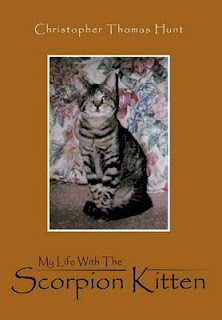
Chris Hunt is my uncle, and he wrote a book. It's called My Life with the Scorpion Kitten and it's about his life over the five-year period he spent with Mathias, a cat he adopted with his wife, my mom's sister, my aunt Tina.
Early in kitten-hood Mathias got a severe eye infection that cost him an eye, and left him blind in the eye he still had. He also had the feline leukemia virus, so I'll tell you straight up, dudes -- the book can carry the sadness at times. But from my personal perspective, what I found most interesting was the insight it offered into my family and some of the people in it.
The book covers the 5 years of Mathias's life, from 2003 to 2008. I lived in Chicago when it started and was just starting to wade back into the life of an undergrad. I started college right out of high school (CLASS OF 97 RULES), but after two years of bopping through the University of Cincinnati, I gradually dropped out of all of my classes. My last semester at UC had basically been a money pit, where my body knew I had dropped out (sleeping til 2pm or so) long before my brain had accepted it (obviously, blowing off my English Lit classes was simply the first the step toward changing my major to anthropology). But in 2003 I was attending classes at Columbia College Chicago as a Fiction Writing major. By the spring of 2008 I had earned my BA, left Chicago, and was wrapping up my MFA in Writing at California College of the Arts in San Francisco. Which is to say -- it was an eventful time in my life and I probably wasn't paying the best attention to family goings-on in Ohio. So in a lot of ways reading Chris's book was like reading one of those novels that gives a parallel view to stories you think you know well.
My grandmother passed away on Christmas Eve of 2004, and the way Chris writes about that night is different from the way I remember it. Chris is probably right -- I'm just surprised that I'd filled in so many details so incorrectly. I remembered our entire family being at Chris & Tina's that night -- my folks, my brother's family, my mom's older brother John and all of his kids. Grandma Mathews had been sick for a long time, and she'd been moved from hospice to Chris and Tina's, and she passed away while we were all there in the house. It was a strange, significant, sad Christmas. But Chris writes that John and his kids weren't there at all, and that John only came after Grandma had passed. I think that's probably true, but in my memory I'd created an entirely different sequence of events. Without reading Chris's book, I never would have entertained the thought I was wrong.


Early in kitten-hood Mathias got a severe eye infection that cost him an eye, and left him blind in the eye he still had. He also had the feline leukemia virus, so I'll tell you straight up, dudes -- the book can carry the sadness at times. But from my personal perspective, what I found most interesting was the insight it offered into my family and some of the people in it.

The book covers the 5 years of Mathias's life, from 2003 to 2008. I lived in Chicago when it started and was just starting to wade back into the life of an undergrad. I started college right out of high school (CLASS OF 97 RULES), but after two years of bopping through the University of Cincinnati, I gradually dropped out of all of my classes. My last semester at UC had basically been a money pit, where my body knew I had dropped out (sleeping til 2pm or so) long before my brain had accepted it (obviously, blowing off my English Lit classes was simply the first the step toward changing my major to anthropology). But in 2003 I was attending classes at Columbia College Chicago as a Fiction Writing major. By the spring of 2008 I had earned my BA, left Chicago, and was wrapping up my MFA in Writing at California College of the Arts in San Francisco. Which is to say -- it was an eventful time in my life and I probably wasn't paying the best attention to family goings-on in Ohio. So in a lot of ways reading Chris's book was like reading one of those novels that gives a parallel view to stories you think you know well.
My grandmother passed away on Christmas Eve of 2004, and the way Chris writes about that night is different from the way I remember it. Chris is probably right -- I'm just surprised that I'd filled in so many details so incorrectly. I remembered our entire family being at Chris & Tina's that night -- my folks, my brother's family, my mom's older brother John and all of his kids. Grandma Mathews had been sick for a long time, and she'd been moved from hospice to Chris and Tina's, and she passed away while we were all there in the house. It was a strange, significant, sad Christmas. But Chris writes that John and his kids weren't there at all, and that John only came after Grandma had passed. I think that's probably true, but in my memory I'd created an entirely different sequence of events. Without reading Chris's book, I never would have entertained the thought I was wrong.

Mathias, the Scorpion Kitten in question.
Chris's book has rippled quietly through the family, if it's even fair to say that much. I've been writing my novel for -- yikes dudes -- almost ten years now. I'm certainly near the end, but it's more than a little humbling for Chris's book to start off by saying that he's writing the first words in 2008, and for it to include a section in which he reads my novel-in-progress, and wondering when the end will come. All of which is to say, I've known for a while he was writing a memoir of his life with Mathias, but it was still a surprise when my mom called one day to say that it was available on Amazon. She sounded kind of excited, but not in a pleasing way. I think it's fair to say that my family doesn't always talk to each other easily about -- you know -- feelings. It's always been that way, and it's always felt uncomfortable (at best) or even like an act of great contrary will to talk to each other about things that we feel, or about things that someone else feels. Chris married into our family, but I get the feeling that this could be true of his family life too. So for him to write and publish a book that is almost entirely a journey through his inner life, examining what he feels and why, and how he feels about others, is, I think, causing some turmoil around the Jent/Mathews axis.
I don't think it's bad or wrong of him to do this. But my mom was nervous about the book, I think Aunt Tina is too. My writing about him writing about it is probably a cause for tense nerves too, but what I read in Chris's book is an attempt to have a conversation with his friends and family about things that are hard to talk about. The bulk of the book is about Mathias and the other cats Chris & Tina have lived with and cared for, but an undercurrent of it is their attempts -- or, Chris's wishes -- to have children. They never did, and in the book's afterword he simply states that "We also learned that we are unable to have children." I feel like that's what the book is really about -- much of it is concerned with the passage of time, with family and friends who have passed on. The cats Chris and Tina adopt are loved by them, but people live a lot longer than cats. They are born and live and pass on while people are still around. Children are meant to survive their parents, to carry on and to be part of a continuity of family and love. Cats are loved -- I have one of my own -- but they're not comparable to children or what children represent. They just can't be. When I asked my mom if she'd ever talked to Tina about their desire or ability to have kids, she said she'd never asked. She didn't think it was her business.
And I guess that's kind of true? But the truth of that statement is getting in the way of a deeper kind of connection that I think everyone in my family lacks, yet desires very much. I was home for a week and half this Christmas, and it was good to be home, but it was a tense time. The specific reason is difficult to pinpoint. But it seems like everyone walks on spiderwebs -- not putting too much pressure on any specific place, or else the whole thing might fall apart. We joke with each other and watch TV together or Christmas shop together, but it's hard to have a conversation that runs deeper than surface concerns.
My dad and my brother in particular are having trouble connecting, because when they talk they have a hard time getting beyond "here are the ways you've wronged me." Both have strong points of view, and their relationship goes back 40 years, you know? Chris writes in his book about times he's been angry with people in our family, or his mother, but in a way that I think is remarkable healthy and honest. I hope it's not something that causes a rift or a fight, and I don't think he ever says anything that anyone should be offended by. But the act of communication can be offensive to some -- or, at least, it is alien in a way that causes gut-level offense, due to its strangeness. I think the best thing that could happen to my brother and my dad is for them to get caught in a log cabin during a snowstorm.

Or, you know when Spider-Man and J. Jonah Jameson used to get handcuffed to a bomb together and they learn to set aside their differences and work together? Something like that could work.

They only need to talk, but they need to talk for a long time. Like when you're having a fight with your boyfriend or girlfriend or husband or wife, and the talk goes over peaks and valleys that are good, then bad, then good again, and you wind up in a place where you're exhausted, but emotionally vulnerable, and saying things that are honest and straightforward and hopefully helpful to everyone.
Well. I've definitely gotten off track here, and the entirety of this post falls under the realm of Things We Don't Talk About in Public, but surely one of the things that's kept me from blogging ever since I read Chris's book is that I knew in order to write about it I'd have to write about things my family doesn't like to talk about. Chris's book is really good and I'm really proud of him for writing it and putting it out in the world. And it could be that saying it here is better than not saying it at all?
Friday, April 01, 2011
We're Oscar Mike
Last week I spent about 24 hours on a train, traveling down to Baltimore and back. I was visiting friends and taking some writing time and getting away from the lingering winter for a long weekend, but with that much time to kill on the train, I did a lot of watching-the-world-go-by. This is Battleboro.

I also watched some TV. I successfully made it into, and out the other side of, Generation Kill, an HBO 7-episode series adapting Evan Wright's book about his time embedding with the First Recon Battalion Marines during the 2003 invasion of Iraq. The series was produced and largely written by David Simon and Ed Burns as their follow-up to The Wire, and it can be similarly difficult to penetrate at first. I'd watched the first two episodes of Generation Kill at least twice before, and never continued through the rest of the show. But over six days and in between train rides, novel rewrites, and long, long drives between Baltimore and DC, I watched all 7 episodes about the drive through Iraq, to Baghdad, and into the unknown of occupation. It's essentially a road trip movie in and of itself, except this road trip involves firefights, Ripped Fuel, and occasionally state-sanctioned murder.
I can't speak from personal experience, but I've read reviews from soldiers -- including some of the Marines Wright was embedded with -- that have called Generation Kill the most accurate portrayal of the life of the modern American soldier. What's important about that isn't just the accurate portrayal of facts -- there's a Booklist review on the book's Amazon page that says:
Today's American soldiers, Wright says, are young men who are "on more intimate terms with the culture of the video games, reality TV shows and Internet porn than they are with their own families." (One 19-year-old corporal compares driving into an ambush to a Grand Theft Auto video game: "It was fucking cool.") Wright also explores how today's pop-culture-driven soldiers differ from those who fought more than three decades ago in Vietnam. A perceptive, often troubling examination of soldiers' view of war, peace, and combat.

And that's a big deal when you're giving those young men guns and telling them to go save the world, but I think it's also a big deal in our day to day life. It's a question of pop culture that's been clouding my vision lately. Reading the AV Club, or Ain't It Cool or any comics website ever, you get the sense of consumption without thought. Sales numbers are reported (box office receipts or paycheck amounts), and reviews are produced heavy on snark and light on introspection. There's a taking in of media and no regard for narrative or the struggle of art or what we think about when we think about ... anything. It's all novelty, irony and sales figures.
That's not an across the board condemnation of reviews. The AV Club tries -- I thought their Glee/Community equation a few weeks ago was insightful in its simplicity -- and io9 regularly posts more in-depth articles than your average bear, like this exploration of why the new V series was a failure of storytelling AND not very much fun as nostalgia junk food, and this long article on when it's the right time to show your kids the Empire Strikes Back or Wrath of Kahn, as well as pop science blogging (The Strange, Sad History of Lobotomy and How Many Groups Reached the Americas Before Columbus? are recent examples). Unfortunately, it suffers from the revamped Gawker layout that keeps me away from that entire family of sites these days.
Meanwhile ... I had a whole digression planned on Marc Maron being condescending toward Joe Rogan on his WTF podcast last week, and basically telling him that he's a bad person for making a living hosting Fear Factor for six years, but I think that just comes down to the fact that Marc Maron can be condescending, and that he thinks liking Fear Factor is wrong because he doesn't like Fear Factor. Instead, I'll leave you with some thoughts on Dragon Age II!
If you're not a video game/fantasy nerd, you might not be aware of Dragon Age II. It's an action role-playing game that features the option to romance lots of different kinds of white people -- male or female! The controversy in previous games like this has been that gay or bisexual romances were possible -- if you made a male character, you could engage in an awkward and clothed cutscene with another male character. So, you know. Gays! In our video games! Scandalous, right?

None of these romances are particularly sexy, whether they're male-male, male-female, female-female, or elf-whatevs. The characters move awkwardly and no one ever takes their medieval fantasy underpants off. But the scandal regarding Dragon Age II comes from one particular gamer, posting on the game's bulletin board (there are still internet bulletin boards!) that having so MANY options for romance infringes on his rights as a straight male gamer.
"In every previous BioWare game, I always felt that almost every companion in the game was designed for the male gamer in mind. Every female love interest was always written as a male friend type support character. In Dragon Age 2, I felt like most of the companions were designed to appeal to other groups foremost, Anders and Fenris for gays and Aveline for women given the lack of strong women in games, and that for the straight male gamer, a secondary concern. It makes things very awkward when your male companions keep making passes at you. The fact that a "No Homosexuality" option, which could have been easily implemented, is omitted just proves my point. I know there are some straight male gamers out there who did not mind it at and I respect that."
No kidding! Now, this probably wouldn't have gotten any more coverage than your average internet troll, except that one of the writers on DA2 followed it up with a thoughtful, incisive, and overall excellent rebuttal:
"And if there is any doubt why such an opinion might be met with hostility, it has to do with privilege. You can write it off as "political correctness" if you wish, but the truth is that privilege always lies with the majority. They're so used to being catered to that they see the lack of catering as an imbalance. They don't see anything wrong with having things set up to suit them, what's everyone's fuss all about? That's the way it should be, any everyone else should be used to not getting what they want."
There's more in the link above, but the story morphed even more when a petition was posted online to have David Gaider fired for stereotyping gays by having one of the gay romance options in DA2 gain "rivalry points" if your male character spurns his romantic advances. The petitioner's argument being, I think, that this implies that all gay men aggressively pursue sex, whether the object of their affection wants it or not. I don't think that's the POV of the character in question, but regardless of that -- one of the gentlemen from Penny Arcade (it was Tycho, but to be honest, I can't keep track of what their real names/character names are) posted in a blog this morning to say:
"It reminds me of when I first saw Samus Aran's face in Metroid: Prime, my face, flashed inside the visor, saw my eyes, which were her eyes, blinking at the brightness. These are truly alien experiences for me, and I'm exposed to them and enriched by them because I didn't have to fill out some questionnaire before playing the game to make it aware of my sacred boundaries. I wasn't given the option to check the "No Homos" box, or to choose an elf with a less bewitching accent. Instead, I was dropped hip-deep into the Inferno Round of a moral quiz show. I just want to shake these people sometimes. Hey. That feeling, the one that you're feeling?
"That IS the game."
I'll repeat it for emphasis: "That feeling, the one that you're feeling? That IS the game."
If you experience art and you're left feeling sullied, unusual, confused, angry perhaps -- that's the point. If you get everything you want exactly how you want it, left with no questions, nagging desires, or sense of wonder -- well, it might have been a nice way to spend a few hours. But then what?


I also watched some TV. I successfully made it into, and out the other side of, Generation Kill, an HBO 7-episode series adapting Evan Wright's book about his time embedding with the First Recon Battalion Marines during the 2003 invasion of Iraq. The series was produced and largely written by David Simon and Ed Burns as their follow-up to The Wire, and it can be similarly difficult to penetrate at first. I'd watched the first two episodes of Generation Kill at least twice before, and never continued through the rest of the show. But over six days and in between train rides, novel rewrites, and long, long drives between Baltimore and DC, I watched all 7 episodes about the drive through Iraq, to Baghdad, and into the unknown of occupation. It's essentially a road trip movie in and of itself, except this road trip involves firefights, Ripped Fuel, and occasionally state-sanctioned murder.
I can't speak from personal experience, but I've read reviews from soldiers -- including some of the Marines Wright was embedded with -- that have called Generation Kill the most accurate portrayal of the life of the modern American soldier. What's important about that isn't just the accurate portrayal of facts -- there's a Booklist review on the book's Amazon page that says:
Today's American soldiers, Wright says, are young men who are "on more intimate terms with the culture of the video games, reality TV shows and Internet porn than they are with their own families." (One 19-year-old corporal compares driving into an ambush to a Grand Theft Auto video game: "It was fucking cool.") Wright also explores how today's pop-culture-driven soldiers differ from those who fought more than three decades ago in Vietnam. A perceptive, often troubling examination of soldiers' view of war, peace, and combat.

And that's a big deal when you're giving those young men guns and telling them to go save the world, but I think it's also a big deal in our day to day life. It's a question of pop culture that's been clouding my vision lately. Reading the AV Club, or Ain't It Cool or any comics website ever, you get the sense of consumption without thought. Sales numbers are reported (box office receipts or paycheck amounts), and reviews are produced heavy on snark and light on introspection. There's a taking in of media and no regard for narrative or the struggle of art or what we think about when we think about ... anything. It's all novelty, irony and sales figures.
That's not an across the board condemnation of reviews. The AV Club tries -- I thought their Glee/Community equation a few weeks ago was insightful in its simplicity -- and io9 regularly posts more in-depth articles than your average bear, like this exploration of why the new V series was a failure of storytelling AND not very much fun as nostalgia junk food, and this long article on when it's the right time to show your kids the Empire Strikes Back or Wrath of Kahn, as well as pop science blogging (The Strange, Sad History of Lobotomy and How Many Groups Reached the Americas Before Columbus? are recent examples). Unfortunately, it suffers from the revamped Gawker layout that keeps me away from that entire family of sites these days.
Meanwhile ... I had a whole digression planned on Marc Maron being condescending toward Joe Rogan on his WTF podcast last week, and basically telling him that he's a bad person for making a living hosting Fear Factor for six years, but I think that just comes down to the fact that Marc Maron can be condescending, and that he thinks liking Fear Factor is wrong because he doesn't like Fear Factor. Instead, I'll leave you with some thoughts on Dragon Age II!
If you're not a video game/fantasy nerd, you might not be aware of Dragon Age II. It's an action role-playing game that features the option to romance lots of different kinds of white people -- male or female! The controversy in previous games like this has been that gay or bisexual romances were possible -- if you made a male character, you could engage in an awkward and clothed cutscene with another male character. So, you know. Gays! In our video games! Scandalous, right?

None of these romances are particularly sexy, whether they're male-male, male-female, female-female, or elf-whatevs. The characters move awkwardly and no one ever takes their medieval fantasy underpants off. But the scandal regarding Dragon Age II comes from one particular gamer, posting on the game's bulletin board (there are still internet bulletin boards!) that having so MANY options for romance infringes on his rights as a straight male gamer.
"In every previous BioWare game, I always felt that almost every companion in the game was designed for the male gamer in mind. Every female love interest was always written as a male friend type support character. In Dragon Age 2, I felt like most of the companions were designed to appeal to other groups foremost, Anders and Fenris for gays and Aveline for women given the lack of strong women in games, and that for the straight male gamer, a secondary concern. It makes things very awkward when your male companions keep making passes at you. The fact that a "No Homosexuality" option, which could have been easily implemented, is omitted just proves my point. I know there are some straight male gamers out there who did not mind it at and I respect that."
No kidding! Now, this probably wouldn't have gotten any more coverage than your average internet troll, except that one of the writers on DA2 followed it up with a thoughtful, incisive, and overall excellent rebuttal:
"And if there is any doubt why such an opinion might be met with hostility, it has to do with privilege. You can write it off as "political correctness" if you wish, but the truth is that privilege always lies with the majority. They're so used to being catered to that they see the lack of catering as an imbalance. They don't see anything wrong with having things set up to suit them, what's everyone's fuss all about? That's the way it should be, any everyone else should be used to not getting what they want."
There's more in the link above, but the story morphed even more when a petition was posted online to have David Gaider fired for stereotyping gays by having one of the gay romance options in DA2 gain "rivalry points" if your male character spurns his romantic advances. The petitioner's argument being, I think, that this implies that all gay men aggressively pursue sex, whether the object of their affection wants it or not. I don't think that's the POV of the character in question, but regardless of that -- one of the gentlemen from Penny Arcade (it was Tycho, but to be honest, I can't keep track of what their real names/character names are) posted in a blog this morning to say:
"It reminds me of when I first saw Samus Aran's face in Metroid: Prime, my face, flashed inside the visor, saw my eyes, which were her eyes, blinking at the brightness. These are truly alien experiences for me, and I'm exposed to them and enriched by them because I didn't have to fill out some questionnaire before playing the game to make it aware of my sacred boundaries. I wasn't given the option to check the "No Homos" box, or to choose an elf with a less bewitching accent. Instead, I was dropped hip-deep into the Inferno Round of a moral quiz show. I just want to shake these people sometimes. Hey. That feeling, the one that you're feeling?
"That IS the game."
I'll repeat it for emphasis: "That feeling, the one that you're feeling? That IS the game."
If you experience art and you're left feeling sullied, unusual, confused, angry perhaps -- that's the point. If you get everything you want exactly how you want it, left with no questions, nagging desires, or sense of wonder -- well, it might have been a nice way to spend a few hours. But then what?

Tuesday, March 08, 2011
Memory & Monsters
These days I'm spending time with On Monsters: An Unnatural History of Our Worst Fears by Stephen Asma, a book that explores the idea (so far) of monsters and memory. I'm not very far, but one of the things it addresses -- an idea I ran into first on a History Channel/Discovery Channel entertainment-doc about monsters -- is that the myth of the cyclops -- a giant, one-eyed man -- might have come from people in antiquity digging up mammoth bones.

It seems almost too simplistic to consider, but, you know -- you're a dude, you're digging in the ground, you don't know anything about dinosaurs or mammoths or species-gone-extinct. You find this in the ground, you do your best to explain it. That's not to say people in antiquity were stupid or any less imaginative than we are in 2011 -- it's just to say that they had a different foundation for understanding the world around them. Asma also theorizes that the idea of the satyr may come from reports of monkeys in India ("India" apparently meant "anything in Asia where something weird happens"). Dog-faced men from lands beyond may have been baboons (I think). It's all a way of understanding the world. An interesting anecdote comes from Pliny the Elder, who discounts the idea of the werewolf (as DZ might call them, the wolfmans), because according to the story, a man goes into the woods, becomes a wolf for nine years, then becomes a man again only if he's managed to evade any human contact for that near-decade. Then he puts his clothes back on -- the same clothes that have been hanging on a tree for nine years -- and returns to civilization. Pliny, who believed in satyrs and manticores and cyclopses, found the idea of clothes just hanging from a tree for nine years beyond the ken. And the thing is, I totally agree. Better a dog-faced man than a shirt that's just going to hang there for nine years. Nine years!

O Brother Where Art Thou, probably not the best Coen Brothers movie but the one I think about the most, has a cyclops. He's played by John Goodman with a Southern drawl. The movie kicks off with a claim to be adapted from The Odyssey, by Homer, which is honest and direct. I don't know if I've ever written a single thing that I didn't steal from someone else, knowingly or not. O Brother is about a captain of men trying to get home to his wife, having adventures that waylay him, and then when he gets home, he has to battle his wife's new suitors. In my bones I love the archetypal story that is retold in another time. O Brother might not hit the Odyssey beat for beat, but the heart of it is there. It might even reach different conclusions -- but that's part of the struggle. Take this story that is in our bones, tell it right now (even if it's set in a time not our own, we are telling it now), and see how it's different.

Amanda Bynes dressed up as a boy in She's the Man, which is based on Twelfth Night, and which sticks too close to its source for its own good. It's not a bad movie, but it's not a surprising movie, either. I felt the same way about Rango this weekend. Both movies are charming in their own way, both take their stories from stories we already know in our bones (in Rango's case, it's a more general American Western place), but neither of them move beyond their inspiration to talk about what that story means today, the way O Brother does. And that's what I'm trying to talk about -- it's important to tell our stories again, often and imperfectly, and to change them a little bit every time.
I was going to try to tie this all into making shopping lists, and how I do it for groceries and should do it whenever I leave the house. I know I need to buy new pants and new shirts, but when I go out I talk myself out of it, because spending the money seems silly, and buying clothes feels indulgent. But when I go to the grocery store -- it says "oatmeal" on the list, but I don't want oatmeal right now, on a Sunday afternoon, and though my guts tell me not to buy it, I am going to honor the covenant of the list and the wishes of my past self, and I am going to buy oatmeal. And then, Monday morning, all of a sudden I am grateful that I bought that oatmeal after all. Had I listened to my bones, I'd be stuck with just toast.
But I'm not sure how that relates anymore.


It seems almost too simplistic to consider, but, you know -- you're a dude, you're digging in the ground, you don't know anything about dinosaurs or mammoths or species-gone-extinct. You find this in the ground, you do your best to explain it. That's not to say people in antiquity were stupid or any less imaginative than we are in 2011 -- it's just to say that they had a different foundation for understanding the world around them. Asma also theorizes that the idea of the satyr may come from reports of monkeys in India ("India" apparently meant "anything in Asia where something weird happens"). Dog-faced men from lands beyond may have been baboons (I think). It's all a way of understanding the world. An interesting anecdote comes from Pliny the Elder, who discounts the idea of the werewolf (as DZ might call them, the wolfmans), because according to the story, a man goes into the woods, becomes a wolf for nine years, then becomes a man again only if he's managed to evade any human contact for that near-decade. Then he puts his clothes back on -- the same clothes that have been hanging on a tree for nine years -- and returns to civilization. Pliny, who believed in satyrs and manticores and cyclopses, found the idea of clothes just hanging from a tree for nine years beyond the ken. And the thing is, I totally agree. Better a dog-faced man than a shirt that's just going to hang there for nine years. Nine years!

O Brother Where Art Thou, probably not the best Coen Brothers movie but the one I think about the most, has a cyclops. He's played by John Goodman with a Southern drawl. The movie kicks off with a claim to be adapted from The Odyssey, by Homer, which is honest and direct. I don't know if I've ever written a single thing that I didn't steal from someone else, knowingly or not. O Brother is about a captain of men trying to get home to his wife, having adventures that waylay him, and then when he gets home, he has to battle his wife's new suitors. In my bones I love the archetypal story that is retold in another time. O Brother might not hit the Odyssey beat for beat, but the heart of it is there. It might even reach different conclusions -- but that's part of the struggle. Take this story that is in our bones, tell it right now (even if it's set in a time not our own, we are telling it now), and see how it's different.

Amanda Bynes dressed up as a boy in She's the Man, which is based on Twelfth Night, and which sticks too close to its source for its own good. It's not a bad movie, but it's not a surprising movie, either. I felt the same way about Rango this weekend. Both movies are charming in their own way, both take their stories from stories we already know in our bones (in Rango's case, it's a more general American Western place), but neither of them move beyond their inspiration to talk about what that story means today, the way O Brother does. And that's what I'm trying to talk about -- it's important to tell our stories again, often and imperfectly, and to change them a little bit every time.
I was going to try to tie this all into making shopping lists, and how I do it for groceries and should do it whenever I leave the house. I know I need to buy new pants and new shirts, but when I go out I talk myself out of it, because spending the money seems silly, and buying clothes feels indulgent. But when I go to the grocery store -- it says "oatmeal" on the list, but I don't want oatmeal right now, on a Sunday afternoon, and though my guts tell me not to buy it, I am going to honor the covenant of the list and the wishes of my past self, and I am going to buy oatmeal. And then, Monday morning, all of a sudden I am grateful that I bought that oatmeal after all. Had I listened to my bones, I'd be stuck with just toast.
But I'm not sure how that relates anymore.

Subscribe to:
Posts (Atom)