The Longbox Project is a site that asks folks to share memories tied to specific issues in their comic book collections. This technically means "Amazing Spider-Man #258 makes me think of...", but it's just as likely to mean "For 25 years I've carried some low-level guilt around about the time I stole something from my big brother, and I finally have an excuse to confess it."
You don't have to be a writer or a writer-about-comics to take part. It's not a comics criticism site so much as a memory project, and the posts tend to be conversational and honest. I wrote a new one that's up today called I Own This about the fairly traumatic period of my life when I moved from Los Angeles to Vermont to Baltimore in the span of 7 months.
What I said about it on Facebook, and what I wrote down on a legal pad as soon as I'd written the first draft of this piece, is "Sometimes you write something and say it's embarrassing because of how cool it makes you look and you want to seem humble. Sometimes you say it's embarrassing because it reveals the kind of asshole you can be. This is the second kind."
So, it feels very revealing to share this story with my friends and the internet-at-large. Kate and I sat on the couch last night before I officially submitted it so she could read and we could talk about it before I showed it to the world. I'd told Kate parts of the story before, but not the version that's presented there. And there are other parts that aren't in the Longbox version (sorry gang, I was already over the word count, but I'm happy to go on about it in person), and I told Kate those parts too.
I was nervous she'd think less of me. But what she said was, "I don't think learning more could make me think less."
So if you like comics, gossip, cross-country moves, Vermont, or confessionals, go read I Own This on the Longbox Project. I wrote it!
Monday, April 22, 2013

Sunday, April 21, 2013
Not the Kickstarter You're Looking For
I found this Kickstarter via io9, which found it via Superpunch, which listed it with little comments aside from "Pathetic kickstarter a from major artists."
It's a proposed illustrated novel by Bill Willingham & Frank Cho, of Fables & various comics featuring cavewomen, respectively. I'm not an active follower of either man's work, but I've got nothing against them either -- Cho draws a wonderfully glamorous She-Hulk, in my personal opinion -- but this is a dreadful Kickstarter.
The project itself makes me think of the Veronica Mars kickstarter from a few weeks back. It sounds perfectly interesting -- in this case, an illustrated novel about the last descendent of Norse gods, and the primate detective she's teamed up with -- but the rewards involved here are pretty paltry. Post cards and thank yous at the lower levels, and 5-minute phone calls as you get up to $100. If you kick in $10k, you can be served dinner by Cho & Willingham. There's no low-level option to donate and get the book, presumably because Willingham & Cho are going to sell this project to a big-name publisher (and get rightfully paid for doing so), but that no doubt introduces complications with regard to giving actual copies of the actual book away.
The specifics of the Veronica Mars project were different, but essentially it was a film being backed by a major studio who didn't want to pay for it. So they asked fans to pay for it, upfront. There's nothing immoral about that, but to me the spirit of Kickstarter is that it allows people to make something they otherwise couldn't, without crowdfunding. With Veronica Mars, the studio could foot the bill upfront -- they just don't want to.
But where they do deliver above and beyond Willingham & Cho is that backers who pledge $35 actually get a digital copy of the movie. With Bifrost, the proposed illustrated novel, the closest equivalent is for backers who pledge $125 -- they get a signed copy of the book. There's no unsigned or digital equivalent for someone who pledges a lower amount. Willingham & Cho are trying to get paid twice for the same book: once now, from fans who want to donate ahead of time in order to win the chance to buy the book on the shelves later, and again from whoever agrees to publish it.
Like the Veronica Mars project, there's nothing immoral or wrong about going about the process this way. This would be a several-years-long process, and as they say on their page, "this is a Kickstarter project for selecting out the inordinately patient from the rest." But it doesn't sound like it's a project they're especially passionate about, either. Aside from the dreadfully boring video of Willingham describing the project and the process it would involve, the underlying message of this Kickstarter is, here's a project we would do if no other paying gig came up in the meantime, and if fans were willing to throw $30k at us to inspire us give up our downtime to work on it.
There's nothing wrong with asking. But I prefer to back projects that are inspiring, from creators who are willing to put a finished project in their backers' hands.
It's a proposed illustrated novel by Bill Willingham & Frank Cho, of Fables & various comics featuring cavewomen, respectively. I'm not an active follower of either man's work, but I've got nothing against them either -- Cho draws a wonderfully glamorous She-Hulk, in my personal opinion -- but this is a dreadful Kickstarter.
The project itself makes me think of the Veronica Mars kickstarter from a few weeks back. It sounds perfectly interesting -- in this case, an illustrated novel about the last descendent of Norse gods, and the primate detective she's teamed up with -- but the rewards involved here are pretty paltry. Post cards and thank yous at the lower levels, and 5-minute phone calls as you get up to $100. If you kick in $10k, you can be served dinner by Cho & Willingham. There's no low-level option to donate and get the book, presumably because Willingham & Cho are going to sell this project to a big-name publisher (and get rightfully paid for doing so), but that no doubt introduces complications with regard to giving actual copies of the actual book away.
The specifics of the Veronica Mars project were different, but essentially it was a film being backed by a major studio who didn't want to pay for it. So they asked fans to pay for it, upfront. There's nothing immoral about that, but to me the spirit of Kickstarter is that it allows people to make something they otherwise couldn't, without crowdfunding. With Veronica Mars, the studio could foot the bill upfront -- they just don't want to.
But where they do deliver above and beyond Willingham & Cho is that backers who pledge $35 actually get a digital copy of the movie. With Bifrost, the proposed illustrated novel, the closest equivalent is for backers who pledge $125 -- they get a signed copy of the book. There's no unsigned or digital equivalent for someone who pledges a lower amount. Willingham & Cho are trying to get paid twice for the same book: once now, from fans who want to donate ahead of time in order to win the chance to buy the book on the shelves later, and again from whoever agrees to publish it.
Like the Veronica Mars project, there's nothing immoral or wrong about going about the process this way. This would be a several-years-long process, and as they say on their page, "this is a Kickstarter project for selecting out the inordinately patient from the rest." But it doesn't sound like it's a project they're especially passionate about, either. Aside from the dreadfully boring video of Willingham describing the project and the process it would involve, the underlying message of this Kickstarter is, here's a project we would do if no other paying gig came up in the meantime, and if fans were willing to throw $30k at us to inspire us give up our downtime to work on it.
There's nothing wrong with asking. But I prefer to back projects that are inspiring, from creators who are willing to put a finished project in their backers' hands.
Monday, March 25, 2013
In which I reveal crimes against humanity
Yesterday I spent the day watching a Real World San Francisco marathon and writing The Punisher Disapproves, a memory of comic books, brotherly bonding, and theft. It's for The Longbox Project, a new site telling the story of comic collections, one issue at a time.
I have never before admitted to the terrible things revealed in that post, so I humbly await your judgement, understanding, terrible wrath, and/or forgiveness.
I have never before admitted to the terrible things revealed in that post, so I humbly await your judgement, understanding, terrible wrath, and/or forgiveness.
Friday, March 01, 2013
Celebrity & Intimacy
The first time we touch each other again is over Charlie -- we call him KC -- a big, friendly black dog. He's and older fella, the hair under his chin is gone white, and white hairs speckle the rest of his body in a way that reminds us that he's old and getting older, every day. Who isn't?
KC's body is lean. He's a big dog, and petting his back and his body we can feel his ribs and his breath. Our hands and fingers touch each others by accident, and we look at each to recognize this, but never at the same time. I see her eyes as they leave me face, and my eyes leave hers just so.
Her hair is blonder, her smile as perfect. The creases around it a little deeper, her finger and toenails just as bright. Her cheeks are still so round that when she smiles (so big) her eyes look nearly shut.
Outside, I'm with my family. Adam is there too, and so is my dad. My dad is always near when I dream. My family bickers as we perform a chore. The pool deck is in a state of repair, and there's a dump truck that requires sorting. We fight and tensions build -- my mom ignores them, which enrages me, and my dad eggs them on, which enrages me. Again, this is always what happens when I'm dreaming. SJ stops us and guides us through a prayer together. Part of the prayer is the pledge of allegiance, but it still feels spiritual and not secular. It calms us and we can continue to work. This is not what always happens when I dream.
She's overwhelmed by the prayer. She cries and I hold her against me -- my hands are on her bare upper arms -- and I'm reminded of being inside, a moment when she laid on the couch and I crouched close by, and we knew we had just this day together (or just this time together), and this is nice. It's unsaid, but I feel it, and I presume she feels the same.
She lies on a couch that is also a bathtub. The water swirls down the drain, and she's worried one of her scarves will be pulled down too. I do not let it happen.
There's so much I can't put into words, except that when I woke up I wanted to know it forever. I wanted to hold her like that, once. I wanted to be known like that again.
She lives forever for me like that. She lives in Ohio now.
I don't know her anymore, not really. I don't want anything back again. But I occasionally want what was, for a moment in a dream. I want to remember the feeling when I'm awake. I want to see that it's there and that it mattered. I know that it did for me, and I want it to be true for her too. We don't need to acknowledge it, except that I assume that we do, silently and separately, but aligned.
KC's body is lean. He's a big dog, and petting his back and his body we can feel his ribs and his breath. Our hands and fingers touch each others by accident, and we look at each to recognize this, but never at the same time. I see her eyes as they leave me face, and my eyes leave hers just so.
Her hair is blonder, her smile as perfect. The creases around it a little deeper, her finger and toenails just as bright. Her cheeks are still so round that when she smiles (so big) her eyes look nearly shut.
Outside, I'm with my family. Adam is there too, and so is my dad. My dad is always near when I dream. My family bickers as we perform a chore. The pool deck is in a state of repair, and there's a dump truck that requires sorting. We fight and tensions build -- my mom ignores them, which enrages me, and my dad eggs them on, which enrages me. Again, this is always what happens when I'm dreaming. SJ stops us and guides us through a prayer together. Part of the prayer is the pledge of allegiance, but it still feels spiritual and not secular. It calms us and we can continue to work. This is not what always happens when I dream.
She's overwhelmed by the prayer. She cries and I hold her against me -- my hands are on her bare upper arms -- and I'm reminded of being inside, a moment when she laid on the couch and I crouched close by, and we knew we had just this day together (or just this time together), and this is nice. It's unsaid, but I feel it, and I presume she feels the same.
She lies on a couch that is also a bathtub. The water swirls down the drain, and she's worried one of her scarves will be pulled down too. I do not let it happen.
There's so much I can't put into words, except that when I woke up I wanted to know it forever. I wanted to hold her like that, once. I wanted to be known like that again.
She lives forever for me like that. She lives in Ohio now.
I don't know her anymore, not really. I don't want anything back again. But I occasionally want what was, for a moment in a dream. I want to remember the feeling when I'm awake. I want to see that it's there and that it mattered. I know that it did for me, and I want it to be true for her too. We don't need to acknowledge it, except that I assume that we do, silently and separately, but aligned.
Tuesday, February 19, 2013
Satellites
There are places where you only have fun with certain people. That's gravity.
Consistency. Even the uneven kind (what kind of a pattern is 76 years?), it still has the ebb and flow, the push and pull of rhythm. You might not get the math, but you understand enough to trust the process.
Sometimes I'll dream those people. The men and women I only see a few times a year, or the ones I only see every few years. I'll dream that I'm home (which always means Ohio), that I'm in the sunken family room (the fact that there's one-step down into that room from the dining room was always a big deal to me), that Adrian is there with me. He's on the couch, I'm in a chair, the window is open and we can hear the frogs and crickets and toads of the woods behind my house. We didn't spend much time in those woods (those particular woods), but they form the perimeter of our friendship anyway. When I dream of him, I feel like I've seen him. When I dream of him, I dream that he's tired.
I feel the magnets of the midwest. I saw a news headline (unclicked) that asked, Why do meteors explode in midair? I wonder if I'm hurtling back toward the home country, assured of a soft landing in a grassy field, but destined to explode in midair.
I said to someone this weekend, I'd like to get back to the midwest someday.
They said to me, So you consider Ohio the midwest?
Consistency. Even the uneven kind (what kind of a pattern is 76 years?), it still has the ebb and flow, the push and pull of rhythm. You might not get the math, but you understand enough to trust the process.
Sometimes I'll dream those people. The men and women I only see a few times a year, or the ones I only see every few years. I'll dream that I'm home (which always means Ohio), that I'm in the sunken family room (the fact that there's one-step down into that room from the dining room was always a big deal to me), that Adrian is there with me. He's on the couch, I'm in a chair, the window is open and we can hear the frogs and crickets and toads of the woods behind my house. We didn't spend much time in those woods (those particular woods), but they form the perimeter of our friendship anyway. When I dream of him, I feel like I've seen him. When I dream of him, I dream that he's tired.
I feel the magnets of the midwest. I saw a news headline (unclicked) that asked, Why do meteors explode in midair? I wonder if I'm hurtling back toward the home country, assured of a soft landing in a grassy field, but destined to explode in midair.
I said to someone this weekend, I'd like to get back to the midwest someday.
They said to me, So you consider Ohio the midwest?
Monday, February 11, 2013
Superstition, Ritual, Coinicidence
- eating the smaller piece before the bigger piece.
- taking a new way home when I notice my patterns (but only on foot, never in a car).
- the belief that I don't have any superstitions.
- having a thing to drink when I'm writing. water, for the normal things. beer or red bull for the harder things.
- wheaties, orange juice. first the one, then the other.
- Jeopardy during dishes.
- taking the long way from Owensville when I drive into Ohio for the first time in a year.
- one book for the long train, another book for the other.
- we're thinking of each other right now.
- we haven't spoken all day; we want the same thing for dinner.
- we all moved to San Francisco; we all went to school to be writers.
- dude, we ALL moved to San Francisco; we didn't even meet on purpose; I'm the luckiest guy in the world.
Friday, December 07, 2012
Guys, we've got to start blogging more.
In part of the AV Club's favorite-things-of-2012 survey, David Cross responds to "What's the best TV show you watched in 2012?" by pointing out that he doesn't watch TV or own a TV, then names two TV shows that he likes, and I don't think it was a joke.
Thursday, August 02, 2012
"We might unwittingly create the first sentient robots."
http://io9.com/5931389/why-our-current-missions-to-space-could-create-sentient-robots
"Space is the domain of robots. NASA is about to land the semi-autonomous robot Curiosity on Mars within the next few days, where it joins its two less-sophisticated robot brethren, Spirit and Opportunity. There's a good reason why these rovers are the first Earthlings first to set foot — or rather, tire treads — on Mars.
"Even the simplest robot can survive in space better than a human can. As we program more and more of our smart machines to explore space, we might discover a lot more than microbial life in the waters of Europa. Instead, says celebrated science historian Richard Rhodes (author of The Making of the Atomic Bomb), we might unwittingly create the first sentient robots."
"Space is the domain of robots. NASA is about to land the semi-autonomous robot Curiosity on Mars within the next few days, where it joins its two less-sophisticated robot brethren, Spirit and Opportunity. There's a good reason why these rovers are the first Earthlings first to set foot — or rather, tire treads — on Mars.
"Even the simplest robot can survive in space better than a human can. As we program more and more of our smart machines to explore space, we might discover a lot more than microbial life in the waters of Europa. Instead, says celebrated science historian Richard Rhodes (author of The Making of the Atomic Bomb), we might unwittingly create the first sentient robots."
Tuesday, July 10, 2012
Hawking on time travel
It really is that simple. If we want
to travel into the future, we just need to go fast. Really fast. And I
think the only way we're ever likely to do that is by going into space.
The fastest manned vehicle in history was Apollo 10. It reached
25,000mph. But to travel in time we'll have to go more than 2,000 times
faster. And to do that we'd need a much bigger ship, a truly enormous
machine. The ship would have to be big enough to carry a huge amount of
fuel, enough to accelerate it to nearly the speed of light. Getting to
just beneath the cosmic speed limit would require six whole years at
full power.
The initial acceleration would be gentle because the ship would be so big and heavy. But gradually it would pick up speed and soon would be covering massive distances. In one week it would have reached the outer planets. After two years it would reach half-light speed and be far outside our solar system. Two years later it would be travelling at 90 per cent of the speed of light. Around 30 trillion miles away from Earth, and four years after launch, the ship would begin to travel in time. For every hour of time on the ship, two would pass on Earth. A similar situation to the spaceship that orbited the massive black hole.
After another two years of full thrust the ship would reach its top speed, 99 per cent of the speed of light. At this speed, a single day on board is a whole year of Earth time. Our ship would be truly flying into the future.
The slowing of time has another benefit. It means we could, in theory, travel extraordinary distances within one lifetime. A trip to the edge of the galaxy would take just 80 years. But the real wonder of our journey is that it reveals just how strange the universe is. It's a universe where time runs at different rates in different places. Where tiny wormholes exist all around us. And where, ultimately, we might use our understanding of physics to become true voyagers through the fourth dimension.
The initial acceleration would be gentle because the ship would be so big and heavy. But gradually it would pick up speed and soon would be covering massive distances. In one week it would have reached the outer planets. After two years it would reach half-light speed and be far outside our solar system. Two years later it would be travelling at 90 per cent of the speed of light. Around 30 trillion miles away from Earth, and four years after launch, the ship would begin to travel in time. For every hour of time on the ship, two would pass on Earth. A similar situation to the spaceship that orbited the massive black hole.
After another two years of full thrust the ship would reach its top speed, 99 per cent of the speed of light. At this speed, a single day on board is a whole year of Earth time. Our ship would be truly flying into the future.
The slowing of time has another benefit. It means we could, in theory, travel extraordinary distances within one lifetime. A trip to the edge of the galaxy would take just 80 years. But the real wonder of our journey is that it reveals just how strange the universe is. It's a universe where time runs at different rates in different places. Where tiny wormholes exist all around us. And where, ultimately, we might use our understanding of physics to become true voyagers through the fourth dimension.
Monday, June 25, 2012
One About Ma
An important thing to keep in mind: not a one of us has the complete picture. We all see a small piece of who she is. She is a grandmother to me (always will be), she is a mother, a great-grandmother, a neighbor, a friend. She is also a sister. She is a wife and a daughter, too.
She has been unreasonably kind and forgiving – she
introduced me to the reality of absolute, unconditional love and support – and
she is sometimes easily and unnecessarily mean. She hangs up the phone when she
is done speaking and does not say goodbye. She says she is going outside for a
smoke, and then takes the opportunity to slip away unnoticed. She burns
photographs and artifacts you would rather her keep, and then sometimes, weeks
or years later, wonders where they’ve got to.
She hides money for you under the Scarlett O’Hara statue in
her living room. She sits in the kitchen with you for as long as you want to,
and she answers every question you are brave enough to ask.
I once asked her about the first time she came to Leslie
Fry’s farm. What it was like and how it was different. She said she had one
stipulation for moving from Covington, Kentucky – the city – out to Weaver
Road, Ohio – very much the country – and it was that Pa have a bathroom built
onto the side of his house, with running water, a toilet, a bath. She was
bringing herself and two teenage boys, don’t forget, who were used to the finer
things in life, like indoor plumbing. He said okay.
She remembered coming out to Weaver Road on a day she and Pa
had chosen to go shopping for a bathtub and a sink and toilet. When she pulled
into the driveway she parked alongside a brand new, shiny red combine, and she
knew they would not be going shopping for a bathtub that day. She married him
anyway.
I remember the mirror shed used to put her makeup on. A
magnification mirror that made my face look larger than it was. I could see my
pores, I could see myself closer than I really was. I imagine that’s how she
saw me all the time. That she knew me for more than I was.
She likes angels. At one point, she filled her house with
them. The first Christmas present I remember getting her as an adult, as
someone with a job and with money to spend, was a silly poster in a simple
frame. It was a poster of a painting of an angel. I felt embarrassed to be
giving it to her really, because it wasn’t like anything that she had. It was a
poster. I had posters in my dumpy
college apartment, my grandmother did not have posters in her home.
I gave it to her anyway. She hung it up over her bed
in her bedroom.
I remember taking long, long drives out to her mother’s house. I feel like we ate
fried chicken there, but I might be getting my dim memories of
great-grandparents mixed up. There were cousins and aunts and uncles there I’d
never met before, who I was told were part of my family. I was very shy as a
kid, just like I’m very shy as an adult, and I don’t remember talking to any of
these cousins and aunts and uncles. But I remember staying the night at Grandma
Cox’s, and sleeping next to my brother David, and I remember him telling me a
story to send me off to sleep. He told me the story of Jack and the Beanstalk.
It wasn’t the first time I’d heard it, but it’s the only time that I can
remember, now, specifically, of hearing it. And Dave, whether you remember that
or not, I want you to know that I do, and that I will forever.
David tried to take Ma on an Alaskan cruise once. I think
she debated it for a while, and then she decided not to go. I imagine the
reasons why are many and unknowable for anyone but her, but when I asked her
she told me two things. She doesn’t like to go somewhere so far away that she
can’t make it back to her own bed at night, and she doesn’t want to spend money
on something she can’t hold and see afterward. The experience is not good enough for her. Pictures aren’t either. And I don’t agree with that point of view,
but it is her point of view, and I
think I appreciated her sharing with me her why-not. But secretly, I think she
would have loved it.
She once told me not to expect any monetary inheritance,
because she planned on spending all of her money on her children and
grandchildren and great-grandchildren while she was alive to see it spent. It
made her happy. It made her very happy. And I might be tempted to point out
that that is an experience she has
bought, but such arguments of logic would do no good. The heart wants what it
wants.
I lived down the road from Ma and Pa from the day I was
born, and as you know, Ohio experiences all four seasons very deeply. Winter is
cold, summer is hot. I shoveled her sidewalk in the snow sometimes, but still
when I think of Ma and Pa as people
and as a place, I think of summer. Watermelon – Pa put salt on his, and I
thought that’s how everyone ate watermelon – I found out many years later that
some humans are horrified when you do this. Ma in shorts and short-sleeved
button-up plaid shirts. Ma on a bench-swing. Ma feeding her cats and feeding
Zeke cheese sandwiches when she came home from work, which was after midnight.
Pepsi in a can and Pa’s homemade ice cream, sitting on the sidewalk, in that
concrete space between the house and the summer kitchen. Pa at the kitchen
table, carving up a grapefruit with a knife. Is that even true? I don’t know,
but I can see it. I can see it like I’m eight years old and always have been,
and like I will never age.
Maybe I’m feeling sentimental, but when I think of her and
him and them both, it will be summer for all time. It is always June when I
think of Corlene.
If I can speak directly to Ma, for a moment:
You made it very clear that you love me and are proud of me,
and what I want you to know is that I love you and I’m so proud of you, too. Of
the choices you made that changed the course of your own life and our family
forever, for the battles you fought for us, and the sacrifices you made to make
our lives better. Everything anyone in this family ever does – it is because of
the foundation you built on Weaver Road. I love this place and this farm. It
made us.
If I spend the rest of my life turning that fact over and
over in my mind, I will still never unravel it.
I can’t properly explain how large you are in my life, so I
wrote this for you, and I am going to show it to you, and to everyone I know,
and to everyone who will never meet you, I will tell them: you really missed
something special. But you are in luck – because I’m going to tell you about Ma
Fry.

Thursday, March 01, 2012
SpringSpringSpring
Every other day in Baltimore has been a spring. Then the cold returns, and me and Kate sing Christmas songs to each other. Today it's spring again, and it makes me think of Chicago. I can't remember if that's always been true.
It makes me think of recommitment and starting new projects. I like it when I'm not the only one. I got an email from Adrian last week saying we should make a new movie before we're old men in rocking chairs. Just a few days before that I'd been thinking about the kung-fu movie we made in high school, and how if I wanted to watch it again I'd need to buy a VCR. Do they make VCRs that connect to computers? I would put that kung-fu movie onto the youtubes in a heartbeat.
Starting new projects makes me think of finishing old ones. I'd wanted to finish the next draft of my book by Thanksgiving, then by Christmas, and then I started to wonder (again) if I'd ever finish it. Adam finished his and had it Lulued and everything. Our writing group is meeting to talk about it next Friday, so I started to plan on finishing my book by then, too. I only have 8 chapters left to revise, so that's pretty doable. In theory, right?
Comic books I've read recently and liked:
Prophet, being a continuation/bold new direction of a 90s Image comic that I never read.
Conan the Barbarian, being a continuation/bold new direction of the Dark Horse Conan comics that I've barely read.
Daredevil, being a continuation/bold new direction of the Marvel superhero that I never really liked.
Book-books I've read recently and liked:
The Lost City of Z, being an examination of 20th Century Amazonian explorations, and the missing bones resulting thereof.
Movies I've seen recently and liked:
Gosh, I dunno. The Descendents was pretty good. I bought The New World on blu-ray this weekend, and I want to watch it real bad like. I watched part one of the American Experience Clinton two-parter this morning while I was working, and it seemed pretty good. The dream of the 90s is alive in my living room, y'all.
It makes me think of recommitment and starting new projects. I like it when I'm not the only one. I got an email from Adrian last week saying we should make a new movie before we're old men in rocking chairs. Just a few days before that I'd been thinking about the kung-fu movie we made in high school, and how if I wanted to watch it again I'd need to buy a VCR. Do they make VCRs that connect to computers? I would put that kung-fu movie onto the youtubes in a heartbeat.
Starting new projects makes me think of finishing old ones. I'd wanted to finish the next draft of my book by Thanksgiving, then by Christmas, and then I started to wonder (again) if I'd ever finish it. Adam finished his and had it Lulued and everything. Our writing group is meeting to talk about it next Friday, so I started to plan on finishing my book by then, too. I only have 8 chapters left to revise, so that's pretty doable. In theory, right?
Comic books I've read recently and liked:
Prophet, being a continuation/bold new direction of a 90s Image comic that I never read.
Conan the Barbarian, being a continuation/bold new direction of the Dark Horse Conan comics that I've barely read.
Daredevil, being a continuation/bold new direction of the Marvel superhero that I never really liked.
Book-books I've read recently and liked:
The Lost City of Z, being an examination of 20th Century Amazonian explorations, and the missing bones resulting thereof.
Movies I've seen recently and liked:
Gosh, I dunno. The Descendents was pretty good. I bought The New World on blu-ray this weekend, and I want to watch it real bad like. I watched part one of the American Experience Clinton two-parter this morning while I was working, and it seemed pretty good. The dream of the 90s is alive in my living room, y'all.
Sunday, February 12, 2012


Friday, February 03, 2012
The Five Foundational Texts
My pal Adam has a novel in which the main character brings 5 books with him to college, the 5 tomes that have shaped his brain and his bones up to that point. It's an idea that has stuck with me since I first read it a few years ago, and since I've been rebuilding my library these days I've been thinking about what my Five Foundational Texts might have been...
1.

Advanced Dungeons & Dragons 2nd Edition Player's Handbook
by David "Zeb" Cook, 1989.
This was the rulebook for what still takes up a whole lot of my headspace, even when I'm not actively playing D&D. My brother played D&D, but I never did much more than watch him and his buddies play around the pool table from time to time. But when I was in high school I fell in with some of the kids in band who had a D&D group, and thereafter spent more weekends than not playing in my basement, or John Bennington's living room, or James Laird's dining room. It was partly the swords-and-sorcery, playing pretend part of D&D that made it attractive, but I think it was also the fact that it was a group activity. As a younger kid I mostly played one-on-one, but sitting around a table for Dungeons & Dragons brought about a kind of collaborative storytelling that I've never shaken the jones for. Reading over the handbook between games -- or during some stretches between gaming groups -- brought to mind all of the possibilities for Adventurers and Adventuring Parties, and I definitely imagined and rolled up more characters than I ever put into play. In reasons I still don't entirely understand, I think playing D&D is what encouraged me to move from Ohio to Chicago. Something about "let's see what's over that next rise..."
2.

Marvel Saga
by Peter Sanderson & the Marvel Bullpen, 1985-87.
I could just say "Marvel Comics from the 1980s, specifically whatever my brother Dave had in his footlocker from 1994-1988," but if I had to pare it down to a volume that can exist on a bookshelf it would be this. This one reminds me of play, too -- it was certainly the precursor to the imagined comic books I wrote scripts & summaries for in middle school and high school, and combined with Marvel Universe, it gave me an encyclopedic mythology I could explore, meditate on, interpret, and -- once the idea of the written by credit had sunk in -- contribute to. It was essentially a retelling of the events of the Marvel Universe, in order, beginning with the Celestials arrival on Earth "roughly one million years ago" and their creation of the Eternals and the Deviants, and ending with the Fantastic Four's battle with Galactus from Fantastic Four #s 48-50. The series used blocks of text mixed with original art from vintage Marvel Comics as well as new art used to fill in some of the gaps. Each issue would have some sort of focus -- "See today's X-Factor in their first battle, when they were the original X-Men!" -- but it generally covered the crannies and side stories of the Marvel Universe from Spider-Man to Daredevil to Alpha Flight, making connections that I'd glimpsed in editorial notes of the normal comics I read, but now explained in a way that revealed just how big and interconnected those stories were.
3.

The Greek Myths
Translated/Retold by Robert Graves, 1955.
Speaking of mythologies... there was a hardcover copy of Ancient Greek myths in the Clermont Northeastern Intermediate School Library that I used to check out and re-read over and over again. I don't know now if it was the Robert Graves version -- I kind of doubt it -- but I don't remember much about the specific edition except it was a hardcover, it was gray, it was lacking a dustjacket, and "Greek Myths" was printed in gold on the spine. I'm sure the subject matter fed something similar to the Marvel Comics I read over and over again, but I also think it was an important step toward, you know, reading actual words on paper, understanding and enjoying how they fit together, resonating in a way that comic book word balloons don't. I'm not talking smack about comics as much as I'm saying -- look, they ain't poetry. I remember the version of the Greek Myths I read was simple and sparse in a way that pushed me to fill in the details. The less they told, the more I saw. I checked that book out ever other week, I think. I think about those guys the same way I think about Pete Laub and Jimmy Daniel. My relationships with Zeus and Heracles and Apollo were just as formative as with the guys with whom I pretended to be Lost Boys (the vampires, not the boy runaways).
4.

Macbeth
by William Shakespeare, 1605-ish.
Spectral daggers, witches three, medieval battles -- if I've made anything clear to you in our time together, it is that these things are right up my alley. And if you wanna talk about expanding one's understanding of language's potential -- I mean, "By the pricking of my thumbs/Something wicked this way comes/Open, locks, whoever knocks!" is certainly enough to blow open the brain of a seventeen-year-old me.
And it will always have a place in my heart for being the play that Charlie Hartman, Josh Lawson and I reenacted with sock puppets and Castle Grayskull for our 12th grade English class.

5.

The Illuminatus! Trilogy
by Robert Shea & Robert Anton Wilson, 1975/1984.
Writing this post, I've been surprised at how hard it's been to put an honest-to-gosh novel on here. I remember that for a big chunk of junior high/high school, my answer to What's your favorite book? was The DragonLance Chronicles: Dragons of Autumn Twilight, which was the first book I loved so much that I read it nonstop for three days over one summer break. But looking back, it doesn't stick with me much more than watching lots of GI Joe. It was a fun book, but it didn't change anything about how my brain worked.
Illuminatus!, on the other hand -- it was fun, dirty, weird, and by far the longest book I'd ever read at that point. It also dovetailed nicely with my musical obsession with the KLF/JAMs/Justified Ancients of Mu Mu by sharing some of the same conspiracy theory-fueled mythology. It was the book I carried in my backpack so much that it started to fall apart, and it was the book I most wanted other people to catch me reading. I thought about fnords forever after, I thought about authorial pranks and unreliable narrators, I thought about a plot that comments on itself as you're reading it and dares you to keep up. I didn't necessarily understand all of it then (or now), but I knew that I liked the feelings it made me feel.
I think it would be easier to pull together a list of Foundational Texts from my 20s, and maybe that's what I'll do next. I imagine that list speak more to how I write and what I write about now -- this list, as I look over it, speaks to how I think and what I think about now. Which is what foundational is supposed to mean, yeah?
1.

Advanced Dungeons & Dragons 2nd Edition Player's Handbook
by David "Zeb" Cook, 1989.
This was the rulebook for what still takes up a whole lot of my headspace, even when I'm not actively playing D&D. My brother played D&D, but I never did much more than watch him and his buddies play around the pool table from time to time. But when I was in high school I fell in with some of the kids in band who had a D&D group, and thereafter spent more weekends than not playing in my basement, or John Bennington's living room, or James Laird's dining room. It was partly the swords-and-sorcery, playing pretend part of D&D that made it attractive, but I think it was also the fact that it was a group activity. As a younger kid I mostly played one-on-one, but sitting around a table for Dungeons & Dragons brought about a kind of collaborative storytelling that I've never shaken the jones for. Reading over the handbook between games -- or during some stretches between gaming groups -- brought to mind all of the possibilities for Adventurers and Adventuring Parties, and I definitely imagined and rolled up more characters than I ever put into play. In reasons I still don't entirely understand, I think playing D&D is what encouraged me to move from Ohio to Chicago. Something about "let's see what's over that next rise..."
2.

Marvel Saga
by Peter Sanderson & the Marvel Bullpen, 1985-87.
I could just say "Marvel Comics from the 1980s, specifically whatever my brother Dave had in his footlocker from 1994-1988," but if I had to pare it down to a volume that can exist on a bookshelf it would be this. This one reminds me of play, too -- it was certainly the precursor to the imagined comic books I wrote scripts & summaries for in middle school and high school, and combined with Marvel Universe, it gave me an encyclopedic mythology I could explore, meditate on, interpret, and -- once the idea of the written by credit had sunk in -- contribute to. It was essentially a retelling of the events of the Marvel Universe, in order, beginning with the Celestials arrival on Earth "roughly one million years ago" and their creation of the Eternals and the Deviants, and ending with the Fantastic Four's battle with Galactus from Fantastic Four #s 48-50. The series used blocks of text mixed with original art from vintage Marvel Comics as well as new art used to fill in some of the gaps. Each issue would have some sort of focus -- "See today's X-Factor in their first battle, when they were the original X-Men!" -- but it generally covered the crannies and side stories of the Marvel Universe from Spider-Man to Daredevil to Alpha Flight, making connections that I'd glimpsed in editorial notes of the normal comics I read, but now explained in a way that revealed just how big and interconnected those stories were.
3.

The Greek Myths
Translated/Retold by Robert Graves, 1955.
Speaking of mythologies... there was a hardcover copy of Ancient Greek myths in the Clermont Northeastern Intermediate School Library that I used to check out and re-read over and over again. I don't know now if it was the Robert Graves version -- I kind of doubt it -- but I don't remember much about the specific edition except it was a hardcover, it was gray, it was lacking a dustjacket, and "Greek Myths" was printed in gold on the spine. I'm sure the subject matter fed something similar to the Marvel Comics I read over and over again, but I also think it was an important step toward, you know, reading actual words on paper, understanding and enjoying how they fit together, resonating in a way that comic book word balloons don't. I'm not talking smack about comics as much as I'm saying -- look, they ain't poetry. I remember the version of the Greek Myths I read was simple and sparse in a way that pushed me to fill in the details. The less they told, the more I saw. I checked that book out ever other week, I think. I think about those guys the same way I think about Pete Laub and Jimmy Daniel. My relationships with Zeus and Heracles and Apollo were just as formative as with the guys with whom I pretended to be Lost Boys (the vampires, not the boy runaways).
4.

Macbeth
by William Shakespeare, 1605-ish.
Spectral daggers, witches three, medieval battles -- if I've made anything clear to you in our time together, it is that these things are right up my alley. And if you wanna talk about expanding one's understanding of language's potential -- I mean, "By the pricking of my thumbs/Something wicked this way comes/Open, locks, whoever knocks!" is certainly enough to blow open the brain of a seventeen-year-old me.
And it will always have a place in my heart for being the play that Charlie Hartman, Josh Lawson and I reenacted with sock puppets and Castle Grayskull for our 12th grade English class.

5.
The Illuminatus! Trilogy
by Robert Shea & Robert Anton Wilson, 1975/1984.
Writing this post, I've been surprised at how hard it's been to put an honest-to-gosh novel on here. I remember that for a big chunk of junior high/high school, my answer to What's your favorite book? was The DragonLance Chronicles: Dragons of Autumn Twilight, which was the first book I loved so much that I read it nonstop for three days over one summer break. But looking back, it doesn't stick with me much more than watching lots of GI Joe. It was a fun book, but it didn't change anything about how my brain worked.
Illuminatus!, on the other hand -- it was fun, dirty, weird, and by far the longest book I'd ever read at that point. It also dovetailed nicely with my musical obsession with the KLF/JAMs/Justified Ancients of Mu Mu by sharing some of the same conspiracy theory-fueled mythology. It was the book I carried in my backpack so much that it started to fall apart, and it was the book I most wanted other people to catch me reading. I thought about fnords forever after, I thought about authorial pranks and unreliable narrators, I thought about a plot that comments on itself as you're reading it and dares you to keep up. I didn't necessarily understand all of it then (or now), but I knew that I liked the feelings it made me feel.
I think it would be easier to pull together a list of Foundational Texts from my 20s, and maybe that's what I'll do next. I imagine that list speak more to how I write and what I write about now -- this list, as I look over it, speaks to how I think and what I think about now. Which is what foundational is supposed to mean, yeah?
Wednesday, January 25, 2012
I went running today.
For the second time since I've lived in Baltimore. For the first time, probably, since the summer.
I ran for: 41 minutes and 42 seconds. I traveled a distance of 2.92 miles. I burned 356 calories. My average pace was 14'15", but I'm not sure what that means. Per minute? That can't be right.
(I know these things because my robot phone told me so.)
(My robot phone also shows me a map of the route I ran, colored green where I ran the fastest and colored red where I stopped to walk.)
I never once stopped to lean against a lamp post or a tree.
(This is untrue. I stopped once to wait for a crosswalk sign, and I was kind of mad when it switched to walk before I was ready. That was my first break, and when I was stopped I had to swallow once to keep myself from throwing up. I stopped a second time to put my hand on a tree and lean over and breathe.)
I listened to a WTF podcast as I ran. It was the episode with Donald Glover. After I got home I remembered that the last time I ran it was the summer, and I'd listened to a WTF podcast with Dan Harmon. Donald Glover is Troy on Community and Dan Harmon is the creator of Community. I didn't do this on purpose, except that when I looked at the list of recent WTF guests Donald Glover was the only one who looked interesting who wasn't Russell Brand.
(I really like Russell Brand. Mostly from his talk show appearances, where he comes across as being very charming and funny. I also really liked Arthur. I went to see it by myself at the movies after one of the times Kari moved out of our house in Vermont. When (spoiler alert!) Hobson died, it made me cry. I re-watched Arthur on HBO one and a half times last week and when (spoiler alert!) Hobson died, I felt a gravity in my guts and I teared up a little bit.)
I went running once in Vermont when the snows were heavy. I ran on the bike trail and had to kick my knees up high and leap for the footprints of whoever went running before me. The footprints only went one direction, so on my way back I had to kick my knees up high and leap for my own footprints.
I bought new pants to run in that have a little zipper and pocket right over the butt where I can put a housekey. This removes a lot of stress from my run. I still have to carry my phone, because I haven't bought a new arm-strap-thing and I don't know where my old one has disappeared to. I didn't wear my glasses and once I thought there was a fashionable young lady walking my way as I was running and I thought I was going to impress her with my athleticism, but as we passed I realized it was actually a private school boy. I bet I impressed him with my casual friendliness.
I'd like to go out running for about the same period of time (or less), but cover 5 miles. I don't know the best routes to take around Hampden. Some streets in Baltimore don't make me feel nervous at all, and some do, and sometimes I feel both ways about the same streets at different times. Sometimes when I run down streets where I don't feel nervous about crime I feel nervous about people thinking I'm dumb to be running, or assuming I won't go running again after this run because my running clothes are new and my belly is not that of a regular runner's. But today I got mud on the legs of my running pants, and I'm not even going to wash them yet. So what do you think of that?
I ran for: 41 minutes and 42 seconds. I traveled a distance of 2.92 miles. I burned 356 calories. My average pace was 14'15", but I'm not sure what that means. Per minute? That can't be right.
(I know these things because my robot phone told me so.)
(My robot phone also shows me a map of the route I ran, colored green where I ran the fastest and colored red where I stopped to walk.)
I never once stopped to lean against a lamp post or a tree.
(This is untrue. I stopped once to wait for a crosswalk sign, and I was kind of mad when it switched to walk before I was ready. That was my first break, and when I was stopped I had to swallow once to keep myself from throwing up. I stopped a second time to put my hand on a tree and lean over and breathe.)
I listened to a WTF podcast as I ran. It was the episode with Donald Glover. After I got home I remembered that the last time I ran it was the summer, and I'd listened to a WTF podcast with Dan Harmon. Donald Glover is Troy on Community and Dan Harmon is the creator of Community. I didn't do this on purpose, except that when I looked at the list of recent WTF guests Donald Glover was the only one who looked interesting who wasn't Russell Brand.
(I really like Russell Brand. Mostly from his talk show appearances, where he comes across as being very charming and funny. I also really liked Arthur. I went to see it by myself at the movies after one of the times Kari moved out of our house in Vermont. When (spoiler alert!) Hobson died, it made me cry. I re-watched Arthur on HBO one and a half times last week and when (spoiler alert!) Hobson died, I felt a gravity in my guts and I teared up a little bit.)
I went running once in Vermont when the snows were heavy. I ran on the bike trail and had to kick my knees up high and leap for the footprints of whoever went running before me. The footprints only went one direction, so on my way back I had to kick my knees up high and leap for my own footprints.
I bought new pants to run in that have a little zipper and pocket right over the butt where I can put a housekey. This removes a lot of stress from my run. I still have to carry my phone, because I haven't bought a new arm-strap-thing and I don't know where my old one has disappeared to. I didn't wear my glasses and once I thought there was a fashionable young lady walking my way as I was running and I thought I was going to impress her with my athleticism, but as we passed I realized it was actually a private school boy. I bet I impressed him with my casual friendliness.
I'd like to go out running for about the same period of time (or less), but cover 5 miles. I don't know the best routes to take around Hampden. Some streets in Baltimore don't make me feel nervous at all, and some do, and sometimes I feel both ways about the same streets at different times. Sometimes when I run down streets where I don't feel nervous about crime I feel nervous about people thinking I'm dumb to be running, or assuming I won't go running again after this run because my running clothes are new and my belly is not that of a regular runner's. But today I got mud on the legs of my running pants, and I'm not even going to wash them yet. So what do you think of that?
Monday, January 16, 2012
Emoticon, Emoticon, Emoticon
Chris Hunt is my uncle, and he wrote a book. It's called My Life with the Scorpion Kitten and it's about his life over the five-year period he spent with Mathias, a cat he adopted with his wife, my mom's sister, my aunt Tina.
Early in kitten-hood Mathias got a severe eye infection that cost him an eye, and left him blind in the eye he still had. He also had the feline leukemia virus, so I'll tell you straight up, dudes -- the book can carry the sadness at times. But from my personal perspective, what I found most interesting was the insight it offered into my family and some of the people in it.
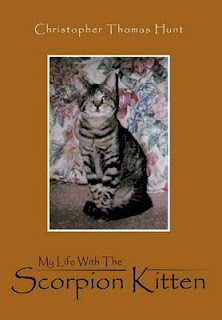
The book covers the 5 years of Mathias's life, from 2003 to 2008. I lived in Chicago when it started and was just starting to wade back into the life of an undergrad. I started college right out of high school (CLASS OF 97 RULES), but after two years of bopping through the University of Cincinnati, I gradually dropped out of all of my classes. My last semester at UC had basically been a money pit, where my body knew I had dropped out (sleeping til 2pm or so) long before my brain had accepted it (obviously, blowing off my English Lit classes was simply the first the step toward changing my major to anthropology). But in 2003 I was attending classes at Columbia College Chicago as a Fiction Writing major. By the spring of 2008 I had earned my BA, left Chicago, and was wrapping up my MFA in Writing at California College of the Arts in San Francisco. Which is to say -- it was an eventful time in my life and I probably wasn't paying the best attention to family goings-on in Ohio. So in a lot of ways reading Chris's book was like reading one of those novels that gives a parallel view to stories you think you know well.
My grandmother passed away on Christmas Eve of 2004, and the way Chris writes about that night is different from the way I remember it. Chris is probably right -- I'm just surprised that I'd filled in so many details so incorrectly. I remembered our entire family being at Chris & Tina's that night -- my folks, my brother's family, my mom's older brother John and all of his kids. Grandma Mathews had been sick for a long time, and she'd been moved from hospice to Chris and Tina's, and she passed away while we were all there in the house. It was a strange, significant, sad Christmas. But Chris writes that John and his kids weren't there at all, and that John only came after Grandma had passed. I think that's probably true, but in my memory I'd created an entirely different sequence of events. Without reading Chris's book, I never would have entertained the thought I was wrong.


Early in kitten-hood Mathias got a severe eye infection that cost him an eye, and left him blind in the eye he still had. He also had the feline leukemia virus, so I'll tell you straight up, dudes -- the book can carry the sadness at times. But from my personal perspective, what I found most interesting was the insight it offered into my family and some of the people in it.

The book covers the 5 years of Mathias's life, from 2003 to 2008. I lived in Chicago when it started and was just starting to wade back into the life of an undergrad. I started college right out of high school (CLASS OF 97 RULES), but after two years of bopping through the University of Cincinnati, I gradually dropped out of all of my classes. My last semester at UC had basically been a money pit, where my body knew I had dropped out (sleeping til 2pm or so) long before my brain had accepted it (obviously, blowing off my English Lit classes was simply the first the step toward changing my major to anthropology). But in 2003 I was attending classes at Columbia College Chicago as a Fiction Writing major. By the spring of 2008 I had earned my BA, left Chicago, and was wrapping up my MFA in Writing at California College of the Arts in San Francisco. Which is to say -- it was an eventful time in my life and I probably wasn't paying the best attention to family goings-on in Ohio. So in a lot of ways reading Chris's book was like reading one of those novels that gives a parallel view to stories you think you know well.
My grandmother passed away on Christmas Eve of 2004, and the way Chris writes about that night is different from the way I remember it. Chris is probably right -- I'm just surprised that I'd filled in so many details so incorrectly. I remembered our entire family being at Chris & Tina's that night -- my folks, my brother's family, my mom's older brother John and all of his kids. Grandma Mathews had been sick for a long time, and she'd been moved from hospice to Chris and Tina's, and she passed away while we were all there in the house. It was a strange, significant, sad Christmas. But Chris writes that John and his kids weren't there at all, and that John only came after Grandma had passed. I think that's probably true, but in my memory I'd created an entirely different sequence of events. Without reading Chris's book, I never would have entertained the thought I was wrong.

Mathias, the Scorpion Kitten in question.
Chris's book has rippled quietly through the family, if it's even fair to say that much. I've been writing my novel for -- yikes dudes -- almost ten years now. I'm certainly near the end, but it's more than a little humbling for Chris's book to start off by saying that he's writing the first words in 2008, and for it to include a section in which he reads my novel-in-progress, and wondering when the end will come. All of which is to say, I've known for a while he was writing a memoir of his life with Mathias, but it was still a surprise when my mom called one day to say that it was available on Amazon. She sounded kind of excited, but not in a pleasing way. I think it's fair to say that my family doesn't always talk to each other easily about -- you know -- feelings. It's always been that way, and it's always felt uncomfortable (at best) or even like an act of great contrary will to talk to each other about things that we feel, or about things that someone else feels. Chris married into our family, but I get the feeling that this could be true of his family life too. So for him to write and publish a book that is almost entirely a journey through his inner life, examining what he feels and why, and how he feels about others, is, I think, causing some turmoil around the Jent/Mathews axis.
I don't think it's bad or wrong of him to do this. But my mom was nervous about the book, I think Aunt Tina is too. My writing about him writing about it is probably a cause for tense nerves too, but what I read in Chris's book is an attempt to have a conversation with his friends and family about things that are hard to talk about. The bulk of the book is about Mathias and the other cats Chris & Tina have lived with and cared for, but an undercurrent of it is their attempts -- or, Chris's wishes -- to have children. They never did, and in the book's afterword he simply states that "We also learned that we are unable to have children." I feel like that's what the book is really about -- much of it is concerned with the passage of time, with family and friends who have passed on. The cats Chris and Tina adopt are loved by them, but people live a lot longer than cats. They are born and live and pass on while people are still around. Children are meant to survive their parents, to carry on and to be part of a continuity of family and love. Cats are loved -- I have one of my own -- but they're not comparable to children or what children represent. They just can't be. When I asked my mom if she'd ever talked to Tina about their desire or ability to have kids, she said she'd never asked. She didn't think it was her business.
And I guess that's kind of true? But the truth of that statement is getting in the way of a deeper kind of connection that I think everyone in my family lacks, yet desires very much. I was home for a week and half this Christmas, and it was good to be home, but it was a tense time. The specific reason is difficult to pinpoint. But it seems like everyone walks on spiderwebs -- not putting too much pressure on any specific place, or else the whole thing might fall apart. We joke with each other and watch TV together or Christmas shop together, but it's hard to have a conversation that runs deeper than surface concerns.
My dad and my brother in particular are having trouble connecting, because when they talk they have a hard time getting beyond "here are the ways you've wronged me." Both have strong points of view, and their relationship goes back 40 years, you know? Chris writes in his book about times he's been angry with people in our family, or his mother, but in a way that I think is remarkable healthy and honest. I hope it's not something that causes a rift or a fight, and I don't think he ever says anything that anyone should be offended by. But the act of communication can be offensive to some -- or, at least, it is alien in a way that causes gut-level offense, due to its strangeness. I think the best thing that could happen to my brother and my dad is for them to get caught in a log cabin during a snowstorm.

Or, you know when Spider-Man and J. Jonah Jameson used to get handcuffed to a bomb together and they learn to set aside their differences and work together? Something like that could work.

They only need to talk, but they need to talk for a long time. Like when you're having a fight with your boyfriend or girlfriend or husband or wife, and the talk goes over peaks and valleys that are good, then bad, then good again, and you wind up in a place where you're exhausted, but emotionally vulnerable, and saying things that are honest and straightforward and hopefully helpful to everyone.
Well. I've definitely gotten off track here, and the entirety of this post falls under the realm of Things We Don't Talk About in Public, but surely one of the things that's kept me from blogging ever since I read Chris's book is that I knew in order to write about it I'd have to write about things my family doesn't like to talk about. Chris's book is really good and I'm really proud of him for writing it and putting it out in the world. And it could be that saying it here is better than not saying it at all?
Friday, January 13, 2012
Strength Is How Strong You Are
Hey guys. What's new?
I have a new Dungeons & Dragons group. My last regular group was during the LA Days, and we played 4th edition. That's the one where the core races & classes are split up over multiple players' handbooks, and everyone gets sweet special moves when they level up. If you get through 2 or 3 combat encounters in a single session, then you're moving at a pretty quick clip.

If it sounds like I'm being harsh toward 4E, then it's because I'm being kind of harsh toward 4E. In general it's true that your D&D game is as fun as you make it, but after running a 4E campaign for a good three months of weekly sessions, by the end it was just lots of searching through papers for the proper power and, to me, a lot of restrictions on what I could make happen on the fly. The encounters in 4E involve a lot of different types of the same monsters -- Kobold Minions, Kobold Skirmishers, Kobold Slingers, Kobold Dragonshields, Kobold Wyrmpriests and Kobold Slyblades -- and a reliance on miniatures that made game prep lots of work and not a lot of fun. In general I'm not a snobby kind of dude, you know? But I think I really decided that 4E isn't for me.
But! After the move to Baltimore I found myself with a cadre of new friends who were interested in some D&Ding. I don't remember now how the idea first came up, but I know that Kate and I invited more people than we thought would/could come, because I figured it was the kind of event where folks would try it, get bored with it, and then maybe half would become regular players. But this very eve we're going to launch our fourth (I think?) session, and so far everyone has come back for more. The players are mostly new to D&D, and I don't think anyone is an RPG aficionado, so I took the opportunity to foist my preferred edition unto their unsuspecting nerd-holes:

In the words of Pierce Hawthorne, "I won Dungeons & Dragons! And it was Advanced!"
I chose 2nd edition partly because I already have a lot of the books, but mostly because my memory of AD&D is that it fosters more role-playing. The rules are there, but kind of loosey-goosey. Even as they expanded into more campaigns and realms of greater PC-customization, there was a core make-it-up-as-you-go to the game that was surely rooted in playing it in high school when no one wanted to actually read the rulebooks cover to cover, but also, I think, inherent to the system. The jump to 3rd edition brought great satisfaction to the players and DMs who wanted every question answered somewhere in the rulebook -- take a look at the size of the Pathfinder Core Rulebook, which is built on the bones of D&D 3.5.

It's probably more true that whatever version of D&D you come to first will be your D&D, regardless of the reasons. Wizards of the Coast have just announced "D&D Next", being the next edition of Dungeons & Dragons, and they did it in the New York Times of all places. 4E came out in 2008, 3E in 2000, and 2E in 1989. That's a slight acceleration of a few years with each new edition, and the reasons are pretty clear. D&D started with Gary Gygax and Dave Arenson at TSR, the product of a couple of guys playing games in their figurative basement. It grew and changed through licensing deals and cartoon shows and toy lines -- re-reading 80s New Mutants comics lately have led me to some rad ads for D&D the game and D&D the product line -- but in the 1990s TSR was bought by Wizards of the Coast, who made their mark on the gaming world with Magic: The Gathering. A few years later, Wizards of the Coast was bought by Hasbro, toy and gaming overlords whose history is the same as most successful 20th century corporations/brands. They had success in the mid-century with things like Mr. Potato Head, and have grown since through mergers and acquisitions. This means that the people currently making Dungeons & Dragons have corporate bosses and conference calls and R&D meetings. I'm not saying Gary Gygax didn't have those over the course of his career, or that AD&D is pure and 4E is not because one was homegrown and the other was playtested at Hasbro-sponsored events. But I am saying that the development of a new set of rules is now more about selling a ton of new core rulebooks, rather than collecting new rules and revisions that have been developed organically by the gaming community.
Part of any given Dungeons & Dragons Edition lifespan is now a planned obsolescence. Maybe that was always true and I was too young or naive or disinterested in such things to observe it before. Maybe it's from having a professional life and seeing office politics play out in a number of environments, so that I can understand better the benefits a major rules overhaul would bring to Wizards of the Coast/Hasbro's year-end sales.
But what I feel in my bones is that I'm having friends over tonight to play AD&D, and the only things it's going to cost us is the price of snacks and beer. Kate & I are going to make a pasta bake and a pot of chili and we're going to sit in my office and pretend to be elves and dwarves and kobolds and owlbears. I'll leave the fighting and the pre-ordering to somebody else.

There's a big difference between playing D&D and being an active member of the D&D online community. As with most online communities, it's full of dark corners and bad attitudes -- but there are two blogs I've been reading since getting back into the game that I feel bring enthusiasm to the topic and show their love of the game. One is Grognardia, written by an RPG creator & enthusiast whose allegiance lies with 1st edition, and the other is The Id DM, written by a gamer who returned to D&D after several years away, and who currently plays 4E. Also, The Escapist did a great series of articles on D&D's Past, Present, and Future, the latest of which is a little outdated now after the "D&D Next" announcement. But still worth a read if you're interested in the game and its history and the people who are invested in either. It's especially illuminating with regard to the switch to 3rd Edition, the Open Gaming License, and the resulting "Edition Wars" that are bound to break out all over again when the new version premieres.

I have a new Dungeons & Dragons group. My last regular group was during the LA Days, and we played 4th edition. That's the one where the core races & classes are split up over multiple players' handbooks, and everyone gets sweet special moves when they level up. If you get through 2 or 3 combat encounters in a single session, then you're moving at a pretty quick clip.

If it sounds like I'm being harsh toward 4E, then it's because I'm being kind of harsh toward 4E. In general it's true that your D&D game is as fun as you make it, but after running a 4E campaign for a good three months of weekly sessions, by the end it was just lots of searching through papers for the proper power and, to me, a lot of restrictions on what I could make happen on the fly. The encounters in 4E involve a lot of different types of the same monsters -- Kobold Minions, Kobold Skirmishers, Kobold Slingers, Kobold Dragonshields, Kobold Wyrmpriests and Kobold Slyblades -- and a reliance on miniatures that made game prep lots of work and not a lot of fun. In general I'm not a snobby kind of dude, you know? But I think I really decided that 4E isn't for me.
But! After the move to Baltimore I found myself with a cadre of new friends who were interested in some D&Ding. I don't remember now how the idea first came up, but I know that Kate and I invited more people than we thought would/could come, because I figured it was the kind of event where folks would try it, get bored with it, and then maybe half would become regular players. But this very eve we're going to launch our fourth (I think?) session, and so far everyone has come back for more. The players are mostly new to D&D, and I don't think anyone is an RPG aficionado, so I took the opportunity to foist my preferred edition unto their unsuspecting nerd-holes:

In the words of Pierce Hawthorne, "I won Dungeons & Dragons! And it was Advanced!"
I chose 2nd edition partly because I already have a lot of the books, but mostly because my memory of AD&D is that it fosters more role-playing. The rules are there, but kind of loosey-goosey. Even as they expanded into more campaigns and realms of greater PC-customization, there was a core make-it-up-as-you-go to the game that was surely rooted in playing it in high school when no one wanted to actually read the rulebooks cover to cover, but also, I think, inherent to the system. The jump to 3rd edition brought great satisfaction to the players and DMs who wanted every question answered somewhere in the rulebook -- take a look at the size of the Pathfinder Core Rulebook, which is built on the bones of D&D 3.5.

It's probably more true that whatever version of D&D you come to first will be your D&D, regardless of the reasons. Wizards of the Coast have just announced "D&D Next", being the next edition of Dungeons & Dragons, and they did it in the New York Times of all places. 4E came out in 2008, 3E in 2000, and 2E in 1989. That's a slight acceleration of a few years with each new edition, and the reasons are pretty clear. D&D started with Gary Gygax and Dave Arenson at TSR, the product of a couple of guys playing games in their figurative basement. It grew and changed through licensing deals and cartoon shows and toy lines -- re-reading 80s New Mutants comics lately have led me to some rad ads for D&D the game and D&D the product line -- but in the 1990s TSR was bought by Wizards of the Coast, who made their mark on the gaming world with Magic: The Gathering. A few years later, Wizards of the Coast was bought by Hasbro, toy and gaming overlords whose history is the same as most successful 20th century corporations/brands. They had success in the mid-century with things like Mr. Potato Head, and have grown since through mergers and acquisitions. This means that the people currently making Dungeons & Dragons have corporate bosses and conference calls and R&D meetings. I'm not saying Gary Gygax didn't have those over the course of his career, or that AD&D is pure and 4E is not because one was homegrown and the other was playtested at Hasbro-sponsored events. But I am saying that the development of a new set of rules is now more about selling a ton of new core rulebooks, rather than collecting new rules and revisions that have been developed organically by the gaming community.
Part of any given Dungeons & Dragons Edition lifespan is now a planned obsolescence. Maybe that was always true and I was too young or naive or disinterested in such things to observe it before. Maybe it's from having a professional life and seeing office politics play out in a number of environments, so that I can understand better the benefits a major rules overhaul would bring to Wizards of the Coast/Hasbro's year-end sales.
But what I feel in my bones is that I'm having friends over tonight to play AD&D, and the only things it's going to cost us is the price of snacks and beer. Kate & I are going to make a pasta bake and a pot of chili and we're going to sit in my office and pretend to be elves and dwarves and kobolds and owlbears. I'll leave the fighting and the pre-ordering to somebody else.

There's a big difference between playing D&D and being an active member of the D&D online community. As with most online communities, it's full of dark corners and bad attitudes -- but there are two blogs I've been reading since getting back into the game that I feel bring enthusiasm to the topic and show their love of the game. One is Grognardia, written by an RPG creator & enthusiast whose allegiance lies with 1st edition, and the other is The Id DM, written by a gamer who returned to D&D after several years away, and who currently plays 4E. Also, The Escapist did a great series of articles on D&D's Past, Present, and Future, the latest of which is a little outdated now after the "D&D Next" announcement. But still worth a read if you're interested in the game and its history and the people who are invested in either. It's especially illuminating with regard to the switch to 3rd Edition, the Open Gaming License, and the resulting "Edition Wars" that are bound to break out all over again when the new version premieres.

Sunday, May 29, 2011
Hot Concrete
The city’s got a feeling summer. Hot concrete. Horizon’s obscured, by buildings or distance or mist. It’s key to choose a city with some green. It gives you that feeling of wet that will permeate your skin -- get under your skin -- get into your clothes. So you’re never quite dry. That’s how you know it’s summer. You’re never dry. Not entirely.
The smell is sweet; sour; sickly; death and birth at once. Baby birds dead on the sidewalk, gray bodies bordered in lines of pink and blue, eyes bulbous and closed, open beaks. Grown birds too, in the same positions -- heads back, stomachs distended, flies and gnats scattering as you walk past. People on porches watch you walk past, they say the neighborhood is changing, not for the better; they say nothing at all and wish you would notice them; they don’t even notice you pass. Stone stairs up to wooden porches, vines and leaves creeping in. You have to push past them. Lines of ants along one step. Occasionally they get inside. They find pop cans. They find cat food.
Inside you hear voices even clearer than out. Kids playing in a pool you can’t see. A woman walking up one side of the street, then the other, then on a block you can’t see but can still hear -- “Britt! Britt! Britt! Britt!” After ten minutes someone yells in response -- not Britt -- and the first woman calls back, “Fuck you, she can hear me!” Hellos, laughs, drunk on booze or the lateness of the hour. It’s always a holiday weekend, especially in the middle of the week.
During the day. Dog walkers, people on cell phones speaking quietly, people who will cross the street whether you’re dangerous or look dangerous or they are. People crane their necks to see in cars or other houses. It’s suspicious, or it looks natural. Radios from cars, from back porches, from roof porches. You can see people who can’t see you back. Somewhere, someone can see you you can’t see back. Around five the bar puts out its patio tables. There is no rush for seats. That comes later, and inside. Things happen there every night. It’s not on a calendar. You just have to go.
At night, blue light from TVs. From your window the street looks orange. It’s the light from the streetlights. There are so many because of the churches and the school. It’s a price you pay. The trade off is that there are also green things, a lawn that is mowed, and lots of street parking.
You worry that no one here knows you. It doesn’t take very long to be known. That’s been a problem in the past. Be more careful this time. Be more patient. Be humble and self-aware. You don’t have to take this advice, just know that it’s good. Remember what you told yourself a long time ago, when you felt very similar: It matters what you do when no one is looking.
The smell is sweet; sour; sickly; death and birth at once. Baby birds dead on the sidewalk, gray bodies bordered in lines of pink and blue, eyes bulbous and closed, open beaks. Grown birds too, in the same positions -- heads back, stomachs distended, flies and gnats scattering as you walk past. People on porches watch you walk past, they say the neighborhood is changing, not for the better; they say nothing at all and wish you would notice them; they don’t even notice you pass. Stone stairs up to wooden porches, vines and leaves creeping in. You have to push past them. Lines of ants along one step. Occasionally they get inside. They find pop cans. They find cat food.
Inside you hear voices even clearer than out. Kids playing in a pool you can’t see. A woman walking up one side of the street, then the other, then on a block you can’t see but can still hear -- “Britt! Britt! Britt! Britt!” After ten minutes someone yells in response -- not Britt -- and the first woman calls back, “Fuck you, she can hear me!” Hellos, laughs, drunk on booze or the lateness of the hour. It’s always a holiday weekend, especially in the middle of the week.
During the day. Dog walkers, people on cell phones speaking quietly, people who will cross the street whether you’re dangerous or look dangerous or they are. People crane their necks to see in cars or other houses. It’s suspicious, or it looks natural. Radios from cars, from back porches, from roof porches. You can see people who can’t see you back. Somewhere, someone can see you you can’t see back. Around five the bar puts out its patio tables. There is no rush for seats. That comes later, and inside. Things happen there every night. It’s not on a calendar. You just have to go.
At night, blue light from TVs. From your window the street looks orange. It’s the light from the streetlights. There are so many because of the churches and the school. It’s a price you pay. The trade off is that there are also green things, a lawn that is mowed, and lots of street parking.
You worry that no one here knows you. It doesn’t take very long to be known. That’s been a problem in the past. Be more careful this time. Be more patient. Be humble and self-aware. You don’t have to take this advice, just know that it’s good. Remember what you told yourself a long time ago, when you felt very similar: It matters what you do when no one is looking.
Monday, April 11, 2011
Where I Write

(very much inspired by this piece on the Rumpus by Chloe Caldwell).
On the left sits Testimony for Man, a history of the City of Hope medical center outside of Los Angeles. It's on top of a Verizon bill I'd rather not open. An iPhone I found under an overpass in L.A. has the headphones plugged in. I use it as an iPod. Most recently I listened to an episode of This American Life about a reporter who confronts the man who raped him when he was a kid. He has an elaborate plan to murder the rapist, but changes his mind when his parents discover what happened by reading an ancient diary. The reporter says, "If you have a secret and you don't want anyone to know it, never write it down." That's a paraphrase. He also says, "Avenge not yourselves, but rather give place unto wrath: for it is written, Vengence is mine; I will repay, saith the Lord." That's from the Bible. Under the iPhone are some tax documents I'd also rather not look at.
A tiny framed painting by James Kochalka leans against an external hard drive. I bought the painting at Wizard World Chicago many years ago, when that was the city where I lived. I like it a lot, and I always keep it near the place where I work. In front of the painting is a cross-stitched Abraham Lincoln K gave me for my birthday this year. Next to that is a small bust of Abraham Lincoln that I bought at Lincoln's birthplace in one of my cross-country drives. That particular drive was in 2008, from Oakland to Ohio, and I bought two of the same bust. I kept one and sent one to SJ. I have a lot of Lincolns in my office, and they're all related to girls in one way or another. What does that say? About me, about Abe?
There are speakers plugged into my computer. My current MacBook is a replacement for the one I spilled Coca-Cola on when I lived in Ohio after grad school. I think it's lasted the longest out of all of my computers. I probably shouldn't have written that -- I'm not superstitious about much except for computers.
On the other side of my computer is a Cincinnati Reds gnome my mom sent to me before my Los Angeles-Vermont cross-country drive. She asked me to take pictures of the gnome as I drove, and I did, even though some kids were a little too-cool-for-school about it. But I thought it was fun, and it was something my mom asked me to do. There are a lot of little action figures next to gnome -- a cylon, Captain Marvel, Thanos, two Spider-Men and a Green Goblin. I don't know what to do with them, but sometimes I pick them up when I'm reading, or when I'm thinking about what to write.
There's a picture frame with family photos in it, also something my mom gave to me. It has pictures of my dad and Ma, my parents' dog Daisy, our backyard in Ohio, a family photo from several Christmases ago (we're all in the picture, so I think it was taken by AM), and a picture of my dad, my brother, Grandpa Jent's tree, and me.
There's a rock in front of the frame, but I don't remember where it came from. Possibly the beach of Lake Champlain, from the visit K and I took here last year, when we decided to move to Vermont. There's a rubber D&D Grell monster, and a heavy lead Watcher statue Pato gave me for my birthday this year. There's a white NBA sweatband I sometimes wear when I'm writing. There are two pens, my current journal, my wallet, and a stack of books: DK Eyewitness Mythology (from K, from birthdays past), the Tanakh, The Emperor of All Maladies, and They Called It the City of Hope, all for work. Beneath the books -- more bills, mostly paid.

Behind me there's a pillow AM made for me long ago, that I use to rest my feet on when I want to write and recline. A calendar, a page torn out from an oversized comic book, Galactus the Devourer of Worlds, and a printer that hasn't worked lately. A copy of Swamplandia! by Karen Russell, and a robot action figure.

Up ahead of me and to the left I have hung up a map of my novel. There's a book case with the books I'm not currently reading, but that I like keeping close -- Popeye comic strips, D&D books, theses and books my friends have written. On top of the bookcase is another Abe, this one wearing Mardi Gras beads, and a concrete Elvis that Sharon gave me longer ago than almost anything else that's happened to me that even counts, as a grown-up anyway. Across from me is the open doorway to the kitchen that won't be mine much longer. I'm terribly nervous that I won't find a place to live with an open workspace like this one. I tend to romanticize where I am, whether that's a good idea or not. I can never imagine finding friends, or finding places to spend my time, that will be as rewarding as the ones I currently have. But then, I always do. That's not to diminish the friends I have, or have made in the past -- every one matters, and I mean it. But there are just *so many* interesting people in the world. They're everywhere, all the time. I want to meet as many as I can.
I'm terribly nervous, and terribly excited.
Saturday, April 02, 2011
Baltimorelandia
I just packed up two boxes of books, and in the second box I included volumes 1&2 of American Elf, the daily comic strip diary of James Kochalka. American Elf was where -- long ago, in the distant early-aughts -- I first heard of a town called Burlington, Vermont. Flash forward several suns, and I've been living on the outskirts of Burlington since last October. You can tell you're in my part of town when you see the spooky boat in the woods.

I came here most recently from LA, which is where I moved after grad school in San Francisco (with a stopover with family in Ohio for a few months in between). When I arrived in LA, I thought I'd be there for a few years at least (and at most), I thought I'd finish my book there, look into some freelance writing gigs, maybe even start teaching. And it's certainly not Los Angeles's fault that it didn't work out that way -- it's a big town with lots of opportunity if you can grab it, and I had a hell of a writing group during my year there. This is a sizeable chunk of said writing group on top of/inside of a giant ball made of sticks at Disneyland.

My reasons for leaving LA are becoming mistier the longer ago it was, but I do think it was the right decision to go. Most of the folks I knew were writers or stand-ups, and they were working their asses off to find/keep/create jobs that I would have entertained as day jobs, but that I would never want to fight for. And there are a LOT of people there who are willing to fight for those jobs, so what was I gonna do? My girl and I grabbed our cat and headed east to Burlington, "the West Coast of the East Coast."

Well, Vermont -- I hardly knew ye. Last week I took a job that will take me down to Baltimore as soon as I can find a place to lay my head down there. I have a cautious excitement about the move. I'm excited to be going back to a larger city -- they have zipcars there! -- but I went for a run yesterday along the Lake Champlain bike trail, and I'll definitely miss the water and the trees and the outdoors here. All the same, for reasons personal, creative, and emotional it's been a struggle to find my people here. Going through a break-up recently has made me feel especially island-like up here on North Cove Road, and a train trip last weekend to Baltimore to visit writerly friends was just what I needed and wanted to clear my head and reassess the next few years. And there just doesn't seem to be a downside to working a job that keeps me creatively engaged, living near people I love who are really good writers (hi Adam and Kate Lynn!), and, frankly, having a new town to explore. I've been moving around a lot for the past few years, and I thought with all my heart that Vermont was going to be home for the foreseeable future. But this weekend a friend said -- "You get used to that life after awhile, of moving to place after place." So maybe I just embrace that for now. I'm finishing a new draft of my book by early summer, and I'm looking forward to a break in the cold. In the billboard of life, Baltimore is the dude with one eye, and I am the girl with the bulbous head.


I came here most recently from LA, which is where I moved after grad school in San Francisco (with a stopover with family in Ohio for a few months in between). When I arrived in LA, I thought I'd be there for a few years at least (and at most), I thought I'd finish my book there, look into some freelance writing gigs, maybe even start teaching. And it's certainly not Los Angeles's fault that it didn't work out that way -- it's a big town with lots of opportunity if you can grab it, and I had a hell of a writing group during my year there. This is a sizeable chunk of said writing group on top of/inside of a giant ball made of sticks at Disneyland.

My reasons for leaving LA are becoming mistier the longer ago it was, but I do think it was the right decision to go. Most of the folks I knew were writers or stand-ups, and they were working their asses off to find/keep/create jobs that I would have entertained as day jobs, but that I would never want to fight for. And there are a LOT of people there who are willing to fight for those jobs, so what was I gonna do? My girl and I grabbed our cat and headed east to Burlington, "the West Coast of the East Coast."

Well, Vermont -- I hardly knew ye. Last week I took a job that will take me down to Baltimore as soon as I can find a place to lay my head down there. I have a cautious excitement about the move. I'm excited to be going back to a larger city -- they have zipcars there! -- but I went for a run yesterday along the Lake Champlain bike trail, and I'll definitely miss the water and the trees and the outdoors here. All the same, for reasons personal, creative, and emotional it's been a struggle to find my people here. Going through a break-up recently has made me feel especially island-like up here on North Cove Road, and a train trip last weekend to Baltimore to visit writerly friends was just what I needed and wanted to clear my head and reassess the next few years. And there just doesn't seem to be a downside to working a job that keeps me creatively engaged, living near people I love who are really good writers (hi Adam and Kate Lynn!), and, frankly, having a new town to explore. I've been moving around a lot for the past few years, and I thought with all my heart that Vermont was going to be home for the foreseeable future. But this weekend a friend said -- "You get used to that life after awhile, of moving to place after place." So maybe I just embrace that for now. I'm finishing a new draft of my book by early summer, and I'm looking forward to a break in the cold. In the billboard of life, Baltimore is the dude with one eye, and I am the girl with the bulbous head.

Friday, April 01, 2011
We're Oscar Mike
Last week I spent about 24 hours on a train, traveling down to Baltimore and back. I was visiting friends and taking some writing time and getting away from the lingering winter for a long weekend, but with that much time to kill on the train, I did a lot of watching-the-world-go-by. This is Battleboro.

I also watched some TV. I successfully made it into, and out the other side of, Generation Kill, an HBO 7-episode series adapting Evan Wright's book about his time embedding with the First Recon Battalion Marines during the 2003 invasion of Iraq. The series was produced and largely written by David Simon and Ed Burns as their follow-up to The Wire, and it can be similarly difficult to penetrate at first. I'd watched the first two episodes of Generation Kill at least twice before, and never continued through the rest of the show. But over six days and in between train rides, novel rewrites, and long, long drives between Baltimore and DC, I watched all 7 episodes about the drive through Iraq, to Baghdad, and into the unknown of occupation. It's essentially a road trip movie in and of itself, except this road trip involves firefights, Ripped Fuel, and occasionally state-sanctioned murder.
I can't speak from personal experience, but I've read reviews from soldiers -- including some of the Marines Wright was embedded with -- that have called Generation Kill the most accurate portrayal of the life of the modern American soldier. What's important about that isn't just the accurate portrayal of facts -- there's a Booklist review on the book's Amazon page that says:
Today's American soldiers, Wright says, are young men who are "on more intimate terms with the culture of the video games, reality TV shows and Internet porn than they are with their own families." (One 19-year-old corporal compares driving into an ambush to a Grand Theft Auto video game: "It was fucking cool.") Wright also explores how today's pop-culture-driven soldiers differ from those who fought more than three decades ago in Vietnam. A perceptive, often troubling examination of soldiers' view of war, peace, and combat.

And that's a big deal when you're giving those young men guns and telling them to go save the world, but I think it's also a big deal in our day to day life. It's a question of pop culture that's been clouding my vision lately. Reading the AV Club, or Ain't It Cool or any comics website ever, you get the sense of consumption without thought. Sales numbers are reported (box office receipts or paycheck amounts), and reviews are produced heavy on snark and light on introspection. There's a taking in of media and no regard for narrative or the struggle of art or what we think about when we think about ... anything. It's all novelty, irony and sales figures.
That's not an across the board condemnation of reviews. The AV Club tries -- I thought their Glee/Community equation a few weeks ago was insightful in its simplicity -- and io9 regularly posts more in-depth articles than your average bear, like this exploration of why the new V series was a failure of storytelling AND not very much fun as nostalgia junk food, and this long article on when it's the right time to show your kids the Empire Strikes Back or Wrath of Kahn, as well as pop science blogging (The Strange, Sad History of Lobotomy and How Many Groups Reached the Americas Before Columbus? are recent examples). Unfortunately, it suffers from the revamped Gawker layout that keeps me away from that entire family of sites these days.
Meanwhile ... I had a whole digression planned on Marc Maron being condescending toward Joe Rogan on his WTF podcast last week, and basically telling him that he's a bad person for making a living hosting Fear Factor for six years, but I think that just comes down to the fact that Marc Maron can be condescending, and that he thinks liking Fear Factor is wrong because he doesn't like Fear Factor. Instead, I'll leave you with some thoughts on Dragon Age II!
If you're not a video game/fantasy nerd, you might not be aware of Dragon Age II. It's an action role-playing game that features the option to romance lots of different kinds of white people -- male or female! The controversy in previous games like this has been that gay or bisexual romances were possible -- if you made a male character, you could engage in an awkward and clothed cutscene with another male character. So, you know. Gays! In our video games! Scandalous, right?

None of these romances are particularly sexy, whether they're male-male, male-female, female-female, or elf-whatevs. The characters move awkwardly and no one ever takes their medieval fantasy underpants off. But the scandal regarding Dragon Age II comes from one particular gamer, posting on the game's bulletin board (there are still internet bulletin boards!) that having so MANY options for romance infringes on his rights as a straight male gamer.
"In every previous BioWare game, I always felt that almost every companion in the game was designed for the male gamer in mind. Every female love interest was always written as a male friend type support character. In Dragon Age 2, I felt like most of the companions were designed to appeal to other groups foremost, Anders and Fenris for gays and Aveline for women given the lack of strong women in games, and that for the straight male gamer, a secondary concern. It makes things very awkward when your male companions keep making passes at you. The fact that a "No Homosexuality" option, which could have been easily implemented, is omitted just proves my point. I know there are some straight male gamers out there who did not mind it at and I respect that."
No kidding! Now, this probably wouldn't have gotten any more coverage than your average internet troll, except that one of the writers on DA2 followed it up with a thoughtful, incisive, and overall excellent rebuttal:
"And if there is any doubt why such an opinion might be met with hostility, it has to do with privilege. You can write it off as "political correctness" if you wish, but the truth is that privilege always lies with the majority. They're so used to being catered to that they see the lack of catering as an imbalance. They don't see anything wrong with having things set up to suit them, what's everyone's fuss all about? That's the way it should be, any everyone else should be used to not getting what they want."
There's more in the link above, but the story morphed even more when a petition was posted online to have David Gaider fired for stereotyping gays by having one of the gay romance options in DA2 gain "rivalry points" if your male character spurns his romantic advances. The petitioner's argument being, I think, that this implies that all gay men aggressively pursue sex, whether the object of their affection wants it or not. I don't think that's the POV of the character in question, but regardless of that -- one of the gentlemen from Penny Arcade (it was Tycho, but to be honest, I can't keep track of what their real names/character names are) posted in a blog this morning to say:
"It reminds me of when I first saw Samus Aran's face in Metroid: Prime, my face, flashed inside the visor, saw my eyes, which were her eyes, blinking at the brightness. These are truly alien experiences for me, and I'm exposed to them and enriched by them because I didn't have to fill out some questionnaire before playing the game to make it aware of my sacred boundaries. I wasn't given the option to check the "No Homos" box, or to choose an elf with a less bewitching accent. Instead, I was dropped hip-deep into the Inferno Round of a moral quiz show. I just want to shake these people sometimes. Hey. That feeling, the one that you're feeling?
"That IS the game."
I'll repeat it for emphasis: "That feeling, the one that you're feeling? That IS the game."
If you experience art and you're left feeling sullied, unusual, confused, angry perhaps -- that's the point. If you get everything you want exactly how you want it, left with no questions, nagging desires, or sense of wonder -- well, it might have been a nice way to spend a few hours. But then what?


I also watched some TV. I successfully made it into, and out the other side of, Generation Kill, an HBO 7-episode series adapting Evan Wright's book about his time embedding with the First Recon Battalion Marines during the 2003 invasion of Iraq. The series was produced and largely written by David Simon and Ed Burns as their follow-up to The Wire, and it can be similarly difficult to penetrate at first. I'd watched the first two episodes of Generation Kill at least twice before, and never continued through the rest of the show. But over six days and in between train rides, novel rewrites, and long, long drives between Baltimore and DC, I watched all 7 episodes about the drive through Iraq, to Baghdad, and into the unknown of occupation. It's essentially a road trip movie in and of itself, except this road trip involves firefights, Ripped Fuel, and occasionally state-sanctioned murder.
I can't speak from personal experience, but I've read reviews from soldiers -- including some of the Marines Wright was embedded with -- that have called Generation Kill the most accurate portrayal of the life of the modern American soldier. What's important about that isn't just the accurate portrayal of facts -- there's a Booklist review on the book's Amazon page that says:
Today's American soldiers, Wright says, are young men who are "on more intimate terms with the culture of the video games, reality TV shows and Internet porn than they are with their own families." (One 19-year-old corporal compares driving into an ambush to a Grand Theft Auto video game: "It was fucking cool.") Wright also explores how today's pop-culture-driven soldiers differ from those who fought more than three decades ago in Vietnam. A perceptive, often troubling examination of soldiers' view of war, peace, and combat.

And that's a big deal when you're giving those young men guns and telling them to go save the world, but I think it's also a big deal in our day to day life. It's a question of pop culture that's been clouding my vision lately. Reading the AV Club, or Ain't It Cool or any comics website ever, you get the sense of consumption without thought. Sales numbers are reported (box office receipts or paycheck amounts), and reviews are produced heavy on snark and light on introspection. There's a taking in of media and no regard for narrative or the struggle of art or what we think about when we think about ... anything. It's all novelty, irony and sales figures.
That's not an across the board condemnation of reviews. The AV Club tries -- I thought their Glee/Community equation a few weeks ago was insightful in its simplicity -- and io9 regularly posts more in-depth articles than your average bear, like this exploration of why the new V series was a failure of storytelling AND not very much fun as nostalgia junk food, and this long article on when it's the right time to show your kids the Empire Strikes Back or Wrath of Kahn, as well as pop science blogging (The Strange, Sad History of Lobotomy and How Many Groups Reached the Americas Before Columbus? are recent examples). Unfortunately, it suffers from the revamped Gawker layout that keeps me away from that entire family of sites these days.
Meanwhile ... I had a whole digression planned on Marc Maron being condescending toward Joe Rogan on his WTF podcast last week, and basically telling him that he's a bad person for making a living hosting Fear Factor for six years, but I think that just comes down to the fact that Marc Maron can be condescending, and that he thinks liking Fear Factor is wrong because he doesn't like Fear Factor. Instead, I'll leave you with some thoughts on Dragon Age II!
If you're not a video game/fantasy nerd, you might not be aware of Dragon Age II. It's an action role-playing game that features the option to romance lots of different kinds of white people -- male or female! The controversy in previous games like this has been that gay or bisexual romances were possible -- if you made a male character, you could engage in an awkward and clothed cutscene with another male character. So, you know. Gays! In our video games! Scandalous, right?

None of these romances are particularly sexy, whether they're male-male, male-female, female-female, or elf-whatevs. The characters move awkwardly and no one ever takes their medieval fantasy underpants off. But the scandal regarding Dragon Age II comes from one particular gamer, posting on the game's bulletin board (there are still internet bulletin boards!) that having so MANY options for romance infringes on his rights as a straight male gamer.
"In every previous BioWare game, I always felt that almost every companion in the game was designed for the male gamer in mind. Every female love interest was always written as a male friend type support character. In Dragon Age 2, I felt like most of the companions were designed to appeal to other groups foremost, Anders and Fenris for gays and Aveline for women given the lack of strong women in games, and that for the straight male gamer, a secondary concern. It makes things very awkward when your male companions keep making passes at you. The fact that a "No Homosexuality" option, which could have been easily implemented, is omitted just proves my point. I know there are some straight male gamers out there who did not mind it at and I respect that."
No kidding! Now, this probably wouldn't have gotten any more coverage than your average internet troll, except that one of the writers on DA2 followed it up with a thoughtful, incisive, and overall excellent rebuttal:
"And if there is any doubt why such an opinion might be met with hostility, it has to do with privilege. You can write it off as "political correctness" if you wish, but the truth is that privilege always lies with the majority. They're so used to being catered to that they see the lack of catering as an imbalance. They don't see anything wrong with having things set up to suit them, what's everyone's fuss all about? That's the way it should be, any everyone else should be used to not getting what they want."
There's more in the link above, but the story morphed even more when a petition was posted online to have David Gaider fired for stereotyping gays by having one of the gay romance options in DA2 gain "rivalry points" if your male character spurns his romantic advances. The petitioner's argument being, I think, that this implies that all gay men aggressively pursue sex, whether the object of their affection wants it or not. I don't think that's the POV of the character in question, but regardless of that -- one of the gentlemen from Penny Arcade (it was Tycho, but to be honest, I can't keep track of what their real names/character names are) posted in a blog this morning to say:
"It reminds me of when I first saw Samus Aran's face in Metroid: Prime, my face, flashed inside the visor, saw my eyes, which were her eyes, blinking at the brightness. These are truly alien experiences for me, and I'm exposed to them and enriched by them because I didn't have to fill out some questionnaire before playing the game to make it aware of my sacred boundaries. I wasn't given the option to check the "No Homos" box, or to choose an elf with a less bewitching accent. Instead, I was dropped hip-deep into the Inferno Round of a moral quiz show. I just want to shake these people sometimes. Hey. That feeling, the one that you're feeling?
"That IS the game."
I'll repeat it for emphasis: "That feeling, the one that you're feeling? That IS the game."
If you experience art and you're left feeling sullied, unusual, confused, angry perhaps -- that's the point. If you get everything you want exactly how you want it, left with no questions, nagging desires, or sense of wonder -- well, it might have been a nice way to spend a few hours. But then what?

Subscribe to:
Posts (Atom)